
Healthcare professionals dedicate their careers to improving patient outcomes, but even the most experienced providers can face allegations of medical negligence. A misunderstanding, documentation error, delayed diagnosis, medication mistake, or unexpected treatment outcome can result in an expensive malpractice claim. Even if a claim is ultimately dismissed, the legal expenses alone can place significant financial pressure on an individual practitioner or medical practice.
Medical malpractice insurance exists to help manage these financial risks. It provides professional liability protection by helping pay for legal defense costs and, when covered under the policy, settlements or court judgments resulting from malpractice claims. For many healthcare professionals, this coverage is not only an important financial safeguard but may also be required by employers, hospitals, licensing boards, or contractual agreements.
This guide explains how medical malpractice insurance works, what it covers, who needs it, common exclusions, premium factors, and how healthcare providers can evaluate policies before requesting insurance quotes.
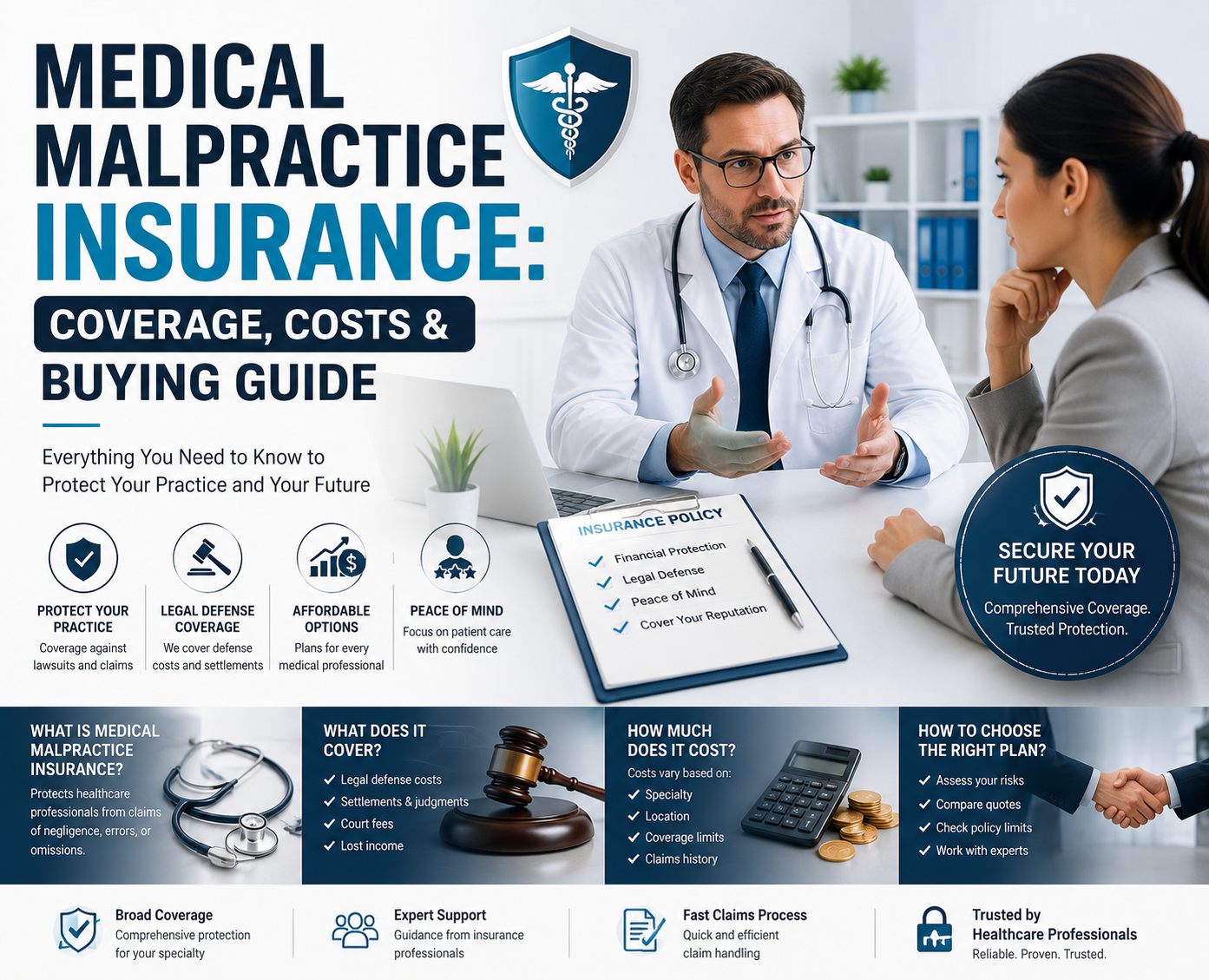
What Is Medical Malpractice Insurance?
Medical malpractice insurance is a specialized form of professional liability insurance designed specifically for healthcare providers. Unlike general liability insurance, which primarily covers bodily injury or property damage occurring on business premises, malpractice insurance addresses claims arising from professional healthcare services.
A malpractice claim generally alleges that a healthcare professional failed to meet the accepted standard of care, causing injury or financial loss to a patient. Whether the allegation involves an actual medical error or an unfounded accusation, defending these claims often requires experienced legal representation, expert witnesses, extensive documentation, and lengthy court proceedings.
A properly structured malpractice policy helps reduce the financial impact of these situations by covering eligible legal expenses and other insured costs according to the policy terms.
Typical incidents that may lead to malpractice claims include:
- Misdiagnosis or delayed diagnosis
- Surgical errors
- Medication mistakes
- Birth-related injuries
- Failure to obtain informed consent
- Anesthesia complications
- Improper treatment decisions
- Documentation errors
- Failure to monitor a patient’s condition
- Telemedicine-related professional mistakes
Why Medical Malpractice Insurance Matters
Modern healthcare involves increasingly complex treatments, evolving technology, electronic health records, and growing patient expectations. Even providers who consistently follow accepted clinical standards may face lawsuits.
Medical malpractice insurance helps healthcare professionals continue practicing with greater financial confidence by transferring much of the legal risk associated with professional services to the insurer, subject to policy terms and limits.
Without appropriate coverage, healthcare providers may be responsible for:
- Attorney fees
- Court costs
- Expert witness expenses
- Settlement negotiations
- Judgment payments
- Administrative investigation expenses (where covered)
- Reputation management support (available under some policies)
For many independent physicians and healthcare practices, a single significant malpractice lawsuit could threaten years of financial investment.
Who Needs Medical Malpractice Insurance?
Medical malpractice insurance is relevant for a wide range of licensed healthcare professionals and organizations. Coverage needs vary depending on specialty, patient volume, procedures performed, contractual obligations, and state regulations.
Professionals who commonly purchase malpractice insurance include:
- Physicians
- Surgeons
- Dentists
- Orthodontists
- Nurse Practitioners (NPs)
- Registered Nurses (RNs)
- Certified Registered Nurse Anesthetists (CRNAs)
- Physician Assistants (PAs)
- Psychiatrists
- Psychologists
- Physical Therapists
- Occupational Therapists
- Chiropractors
- Optometrists
- Podiatrists
- Pharmacists
- Speech Therapists
- Behavioral Health Professionals
- Telemedicine Providers
Healthcare organizations that often require malpractice coverage include:
- Private medical practices
- Dental clinics
- Urgent care centers
- Outpatient surgical facilities
- Behavioral health clinics
- Physical therapy clinics
- Diagnostic imaging centers
- Home healthcare agencies
- Hospitals
- Medical laboratories
Problems Medical Malpractice Insurance Helps Solve
Healthcare providers face professional risks that general business insurance policies are not designed to cover. Medical malpractice insurance addresses financial exposures arising directly from patient care and professional medical services.
Examples include:
- A physician is accused of failing to diagnose cancer early enough.
- A surgeon faces litigation after postoperative complications.
- A dentist is sued following nerve damage during a procedure.
- A therapist is accused of failing to identify a patient’s worsening condition.
- A nurse practitioner allegedly prescribes incorrect medication.
- A telemedicine consultation results in an alleged diagnostic error.
Even when these allegations are ultimately found to lack merit, legal defense costs can be substantial. Malpractice insurance is intended to help manage these expenses within the scope of the policy.
Real-World Risk Scenarios
Scenario 1: Delayed Diagnosis
A patient repeatedly visits a family physician with symptoms that later prove to be a serious illness. The patient alleges that an earlier diagnosis would have improved treatment outcomes. Regardless of the final court decision, the physician may incur significant legal defense costs.
Scenario 2: Surgical Complication
Following a routine procedure, a patient develops unexpected complications and files a malpractice lawsuit alleging negligence during surgery. The healthcare provider must respond to legal proceedings while continuing to operate the practice.
Scenario 3: Medication Error
A prescribing error results in an adverse drug reaction. Although the mistake may have involved multiple healthcare professionals, each provider may require separate legal representation depending on the circumstances.
Scenario 4: Telemedicine Consultation
A physician provides remote medical advice based on limited patient information. The patient later alleges that the virtual consultation resulted in delayed treatment and additional medical complications.
Medical Malpractice Insurance vs. General Liability Insurance
Many healthcare business owners mistakenly assume that general liability insurance protects against malpractice claims. In reality, these policies serve different purposes.
General liability insurance typically addresses third-party bodily injury, property damage, and certain advertising-related claims. Medical malpractice insurance, by contrast, focuses specifically on allegations arising from professional healthcare services, clinical decisions, diagnosis, treatment, or medical advice.
Because these policies address different categories of risk, many healthcare practices carry both forms of coverage as part of a broader business insurance program.
Key Benefits of Medical Malpractice Insurance
- Financial protection against costly malpractice lawsuits.
- Coverage for legal defense expenses, subject to policy terms.
- Support during claim investigations and litigation.
- Greater financial stability for healthcare practices.
- May satisfy hospital credentialing or contractual insurance requirements.
- Helps protect business assets from significant legal expenses.
- Provides peace of mind while delivering patient care.
What Does Medical Malpractice Insurance Cover?
Medical malpractice insurance is designed to protect healthcare professionals against claims arising from alleged professional negligence while providing medical services. The exact protection depends on the insurer, policy wording, endorsements, and selected coverage limits, but most policies include several core protections.
Coverage generally applies when a patient alleges that a healthcare provider failed to meet the accepted standard of care and that the alleged mistake resulted in injury, illness, or financial damages.
Common Coverages Included
- Legal defense costs for covered malpractice claims
- Court filing fees and litigation expenses
- Attorney representation
- Expert witness costs (where covered)
- Settlement payments for covered claims
- Court judgments up to policy limits
- License defense coverage (available on some policies)
- HIPAA or regulatory defense endorsements (where available)
- Medical records review expenses
- Good Samaritan coverage (offered by some insurers)
Coverage applies only within the policy’s terms, exclusions, and liability limits. Reading the policy carefully before purchasing is essential.
What Is Usually Not Covered?
Medical malpractice insurance does not cover every type of legal issue a healthcare provider may face. Policies contain exclusions that vary by insurer.
Common exclusions may include:
- Intentional criminal acts or fraud
- Services performed outside the provider’s licensed scope of practice
- Sexual misconduct claims
- Known incidents that occurred before the policy began (unless specifically covered)
- Employment-related disputes
- General business liabilities
- Property damage unrelated to professional services
- Cyber incidents unless cyber liability coverage is added
Understanding these exclusions helps healthcare professionals avoid unexpected coverage gaps.
Occurrence vs. Claims-Made Policies
One of the most important decisions when purchasing malpractice insurance is choosing between an occurrence policy and a claims-made policy.
Occurrence Policy
An occurrence policy covers incidents that happen while the policy is active, even if the lawsuit is filed years later after the policy has expired.
Advantages:
- Long-term protection
- No tail coverage required
- Simpler long-term coverage management
Potential Drawback:
- Usually higher annual premiums
Claims-Made Policy
A claims-made policy covers claims only if both the incident and the claim occur while the policy remains active (or during an applicable extended reporting period).
Advantages:
- Lower initial premiums
- Popular among private practices
Potential Drawback:
- Tail coverage may be needed when changing insurers, retiring, or closing a practice.
Coverage Comparison Table
| Coverage Feature | Medical Malpractice | General Liability | Cyber Liability |
|---|---|---|---|
| Professional Negligence Claims | ✔ Covered | ✘ Not Covered | ✘ Not Covered |
| Legal Defense Costs | ✔ Usually Covered | ✔ Covered | ✔ Covered |
| Patient Injury from Treatment | ✔ Covered | ✘ No | ✘ No |
| Slip-and-Fall Accidents | ✘ No | ✔ Covered | ✘ No |
| Medical Record Data Breach | Limited | ✘ No | ✔ Covered |
| Property Damage Claims | ✘ No | ✔ Covered | ✘ No |
| Professional Advice Errors | ✔ Covered | ✘ No | ✘ No |
Estimated Medical Malpractice Insurance Costs
Medical malpractice insurance premiums vary significantly because insurers assess the level of professional risk associated with each healthcare provider. A family physician typically pays much less than a neurosurgeon or obstetrician due to differences in claim frequency and potential settlement values.
| Risk Level | Typical Annual Premium Range* | Examples |
|---|---|---|
| Low Risk | $1,500–$5,000 | Physical therapists, counselors, psychologists |
| Moderate Risk | $5,000–$15,000 | Family physicians, internists, pediatricians |
| High Risk | $15,000–$100,000+ | Surgeons, OB-GYNs, anesthesiologists |
*Premiums are illustrative estimates only. Actual pricing depends on specialty, location, claims history, coverage limits, insurer underwriting, and many other factors.
Factors That Affect Insurance Premiums
Insurance companies evaluate numerous underwriting factors before determining premiums. Providers with stronger risk management practices often receive more competitive pricing than those with higher claim exposure.
1. Medical Specialty
Specialties involving surgery, childbirth, anesthesia, or emergency medicine generally carry higher premiums because they present greater liability risks.
2. Geographic Location
Insurance pricing varies by state due to differences in malpractice laws, litigation trends, claim frequency, and regulatory requirements.
3. Claims History
Providers with previous malpractice claims may pay higher premiums than those with clean professional records.
4. Coverage Limits
Higher liability limits typically increase premium costs but provide greater financial protection against severe claims.
5. Deductible Selection
Choosing a higher deductible often lowers annual premiums but increases out-of-pocket costs when a covered claim occurs.
6. Years of Experience
Professional experience, continuing education, and a strong record of patient safety may positively influence underwriting decisions.
7. Patient Volume
Healthcare providers treating a larger number of patients generally face greater exposure to malpractice allegations.
How Insurance Companies Underwrite Medical Malpractice Policies
Before issuing a policy, insurers evaluate the overall risk profile of the healthcare provider or medical organization. This underwriting process helps determine eligibility, coverage options, and premium pricing.
Common underwriting considerations include:
- Medical specialty and procedures performed
- Years in professional practice
- Business revenue
- Number of physicians and employees
- Patient volume
- Licensing status
- Board certifications
- Practice location
- Prior malpractice claims
- Risk management protocols
- Regulatory compliance history
- Use of electronic health records
- Telemedicine services offered
Insurers use this information to assess the likelihood and potential severity of future claims while tailoring coverage to the applicant’s risk profile.
State Regulations and Compliance Considerations
Medical malpractice insurance requirements differ by jurisdiction. Some states require certain healthcare providers or facilities to maintain minimum liability coverage, while others rely on hospital credentialing rules, employer requirements, or contractual obligations.
Healthcare professionals should also consider:
- State licensing requirements
- Hospital credentialing standards
- Minimum coverage limits
- Patient compensation fund participation (where applicable)
- Statutes of limitation for malpractice claims
- Mandatory reporting obligations
Reviewing state-specific regulations and consulting qualified insurance professionals can help ensure compliance and reduce the risk of coverage gaps.
Comparing Major Medical Malpractice Insurance Providers
Choosing a medical malpractice insurance provider involves more than comparing premiums. Healthcare professionals should evaluate financial strength, claims handling, coverage flexibility, customer support, available endorsements, and experience serving their specific medical specialty.
Below is a general comparison of several well-known commercial insurance carriers that offer professional liability solutions for eligible healthcare professionals. Availability, underwriting guidelines, and policy options vary by state and profession.
Insurance Provider Comparison Table
| Insurance Provider | Best For | Coverage Strengths | Pricing Position | Potential Considerations |
|---|---|---|---|---|
| The Hartford | Small and mid-sized healthcare practices | Professional liability, business insurance bundling, risk management resources | Competitive | Coverage options vary by profession and state |
| Hiscox | Independent healthcare professionals and small practices | Flexible professional liability options and online quote process | Competitive | Availability depends on specialty and location |
| Chubb | Larger medical organizations and higher-risk practices | Broad coverage options and strong financial strength | Premium | Higher premiums for expanded coverage |
| Travelers | Growing healthcare businesses | Customizable commercial insurance solutions | Mid-range | Coverage availability varies by underwriting criteria |
| Progressive Commercial | Businesses needing multiple commercial insurance solutions | Business insurance marketplace with access to various coverage options | Competitive | Professional liability products may be offered through partner insurers |
How to Compare Insurance Quotes
Requesting multiple insurance quotes allows healthcare professionals to compare both pricing and policy value. The lowest premium may not provide the broadest protection, so reviewing policy details carefully is essential.
When comparing quotes, consider:
- Per-claim and aggregate liability limits
- Occurrence vs. claims-made policy type
- Defense costs inside or outside policy limits
- Deductible amount
- Tail coverage availability
- Consent-to-settle provisions
- Coverage exclusions
- Additional endorsements
- Financial strength of the insurer
- Claims handling reputation
A comprehensive comparison helps healthcare professionals choose coverage that aligns with their practice’s specific risks rather than focusing solely on premium cost.
How the Medical Malpractice Claims Process Works
Although every claim is unique, most malpractice insurance claims follow a structured process. Understanding these steps can help healthcare providers respond effectively if a claim arises.
Step 1: Incident Reporting
Notify the insurance company as soon as a potential claim or legal notice is received. Delayed reporting could affect coverage under certain policies.
Step 2: Documentation Collection
The insurer may request relevant medical records, treatment notes, informed consent forms, communication logs, billing records, and any other documentation related to the incident.
Step 3: Claims Investigation
Claims professionals review medical records, interview involved parties, consult medical experts, and evaluate whether the claim falls within the policy’s coverage.
Step 4: Legal Defense
If the claim is covered, the insurer generally appoints or approves legal counsel to defend the healthcare provider throughout negotiations or litigation.
Step 5: Settlement or Court Decision
Depending on the circumstances, the claim may be resolved through negotiation, mediation, arbitration, or trial. Any covered settlement or judgment is handled according to the policy terms and limits.
Typical Timeline
- Initial claim review: Several days to a few weeks
- Investigation: Weeks to several months
- Settlement negotiations: Varies significantly
- Court proceedings: May take months or longer depending on jurisdiction
Actual timelines depend on the complexity of the claim, available evidence, legal procedures, and court schedules.
Risk Management Strategies to Reduce Malpractice Exposure
Insurance is only one part of an effective risk management program. Strong clinical practices and operational controls can reduce the likelihood of claims and may positively influence insurance underwriting.
Best Practices
- Maintain complete and accurate patient records.
- Obtain informed consent before procedures.
- Follow evidence-based clinical guidelines.
- Communicate clearly with patients and families.
- Document follow-up recommendations thoroughly.
- Implement regular staff training.
- Review adverse events and near misses.
- Use secure electronic health record systems.
- Verify medication orders carefully.
- Establish quality assurance and peer review programs.
Ways to Help Reduce Insurance Premiums
While insurers determine pricing based on underwriting, healthcare providers can often improve their risk profile through proactive management.
- Maintain a clean claims history where possible.
- Participate in approved risk management education programs.
- Adopt comprehensive patient safety procedures.
- Choose appropriate coverage limits for your practice.
- Consider higher deductibles if financially appropriate.
- Bundle eligible commercial insurance policies.
- Review coverage annually as your practice grows.
- Compare quotes from multiple insurers before renewal.
No strategy guarantees lower premiums, but demonstrating effective risk management may improve underwriting outcomes.
Additional Business Insurance to Consider
Medical malpractice insurance addresses professional liability, but many healthcare practices benefit from additional commercial insurance policies to create broader protection.
| Policy Type | Purpose |
|---|---|
| General Liability Insurance | Protects against third-party bodily injury and property damage claims. |
| Commercial Property Insurance | Covers buildings, medical equipment, furniture, and office contents. |
| Workers’ Compensation Insurance | Provides benefits for employees with work-related injuries or illnesses. |
| Cyber Liability Insurance | Helps manage costs associated with data breaches and cyber incidents. |
| Business Interruption Insurance | May help replace lost income during certain covered business interruptions. |
| Employment Practices Liability Insurance (EPLI) | Addresses certain employment-related claims such as discrimination or wrongful termination. |
Common Mistakes When Buying Medical Malpractice Insurance
- Choosing coverage based only on the lowest premium.
- Ignoring policy exclusions.
- Selecting liability limits that may not match practice risks.
- Overlooking the need for tail coverage.
- Failing to review policy updates each renewal.
- Not comparing quotes from multiple insurers.
- Assuming employer coverage fully protects outside activities.
- Waiting until policy renewal to disclose practice changes.
- Not understanding deductible obligations.
- Purchasing coverage without reviewing endorsements.
Expert Considerations Before Purchasing Medical Malpractice Insurance
Selecting medical malpractice insurance is an important business decision that should be based on your professional responsibilities, specialty, and long-term career plans rather than premium alone. A policy that works well for one healthcare provider may not be appropriate for another.
Before purchasing coverage, consider the following questions:
- What liability limits are appropriate for my specialty?
- Do I need an occurrence or claims-made policy?
- Will I require tail coverage if I change employers or retire?
- Are telemedicine services included?
- Does the policy cover regulatory or licensing investigations?
- What exclusions could affect my practice?
- How experienced is the insurer in handling malpractice claims?
- Are additional endorsements available if my practice expands?
Reviewing these considerations with a licensed insurance professional can help ensure that your policy aligns with your practice’s unique risk profile.
Medical Malpractice Insurance Buying Checklist
Use this checklist before requesting quotes or purchasing a policy:
- ✔ Identify your specialty-specific risks.
- ✔ Determine appropriate liability limits.
- ✔ Compare multiple insurance providers.
- ✔ Review policy exclusions carefully.
- ✔ Understand deductible responsibilities.
- ✔ Confirm whether defense costs are inside or outside policy limits.
- ✔ Evaluate occurrence vs. claims-made coverage.
- ✔ Ask about tail coverage requirements.
- ✔ Verify state licensing and credentialing requirements.
- ✔ Review your coverage annually as your practice evolves.
Frequently Asked Questions (FAQs)
1. What is medical malpractice insurance?
Medical malpractice insurance is a professional liability policy that helps protect healthcare professionals against covered claims alleging negligence, errors, or omissions while providing medical services.
2. Is medical malpractice insurance legally required?
Requirements vary by state, employer, hospital, and licensing authority. Some healthcare professionals must carry coverage, while others obtain it voluntarily to manage financial risk.
3. Who should purchase medical malpractice insurance?
Physicians, surgeons, dentists, nurses, therapists, physician assistants, clinics, hospitals, and many other healthcare providers may benefit from malpractice coverage.
4. How much does medical malpractice insurance cost?
Premiums depend on factors such as medical specialty, geographic location, claims history, coverage limits, deductibles, and the insurer’s underwriting assessment.
5. Does malpractice insurance cover legal defense costs?
Most policies include legal defense expenses for covered claims, although the extent of coverage depends on the policy language and selected limits.
6. What is the difference between occurrence and claims-made coverage?
An occurrence policy covers incidents that happen during the policy period, while a claims-made policy generally requires both the incident and claim to occur while coverage is active, unless extended reporting coverage applies.
7. What is tail coverage?
Tail coverage extends the reporting period for claims-made policies, allowing certain claims to be reported after the policy has ended, subject to policy terms.
8. Does general liability insurance replace malpractice insurance?
No. General liability insurance covers different business risks, such as third-party bodily injury or property damage, while malpractice insurance addresses professional healthcare liability.
9. Can I lower my malpractice insurance premium?
While premiums are determined by the insurer, maintaining strong risk management practices, comparing quotes, selecting appropriate deductibles, and keeping a favorable claims history may improve pricing.
10. How often should I review my policy?
Healthcare professionals should review their insurance annually or whenever there are significant changes to their practice, services, staffing, or business structure.
11. Does malpractice insurance cover telemedicine?
Some policies include telemedicine services, while others require specific endorsements. Always verify coverage details before providing remote healthcare services.
12. How long does a malpractice claim take to resolve?
Timelines vary depending on the complexity of the case, negotiations, court schedules, and the parties involved. Some claims settle within months, while others may take longer.
Conclusion
Medical malpractice insurance plays a vital role in protecting healthcare professionals and medical organizations from the financial consequences of professional liability claims. Whether you operate an independent practice, work within a healthcare system, or provide specialized medical services, having appropriate coverage can help safeguard your career, reputation, and financial stability.
When evaluating policies, look beyond the annual premium. Carefully compare coverage limits, exclusions, policy type, insurer experience, claims support, and available endorsements. Obtaining multiple quotes and reviewing policy details can help you make an informed decision that aligns with your professional responsibilities and long-term goals.
Because insurance needs vary by specialty, state regulations, and practice size, reviewing your coverage regularly and consulting qualified insurance professionals can help ensure your protection keeps pace with changes in your healthcare practice.
Related Topics
- Best Liability Insurance Providers
- Small Business Insurance
- Retail Business Insurance
- Commercial Insurance Guide
- Business Insurance Guide
Educational Disclaimer: This article is intended for general educational and informational purposes only. It does not constitute legal, financial, or insurance advice. Insurance policies, pricing, underwriting guidelines, coverage availability, and regulatory requirements vary by insurer, profession, and jurisdiction. Always review policy documents carefully and consult a licensed insurance professional before purchasing or modifying insurance coverage.