
Travel credit cards are designed for consumers who want to earn rewards on everyday spending and redeem those rewards for travel-related expenses. Depending on the card, rewards may come in the form of points, airline miles, or hotel loyalty credits.
Choosing the right travel credit card requires evaluating rewards structures, annual fees, redemption flexibility, travel protections, and credit requirements. Since no single card fits every traveler, comparing multiple options is essential before applying.
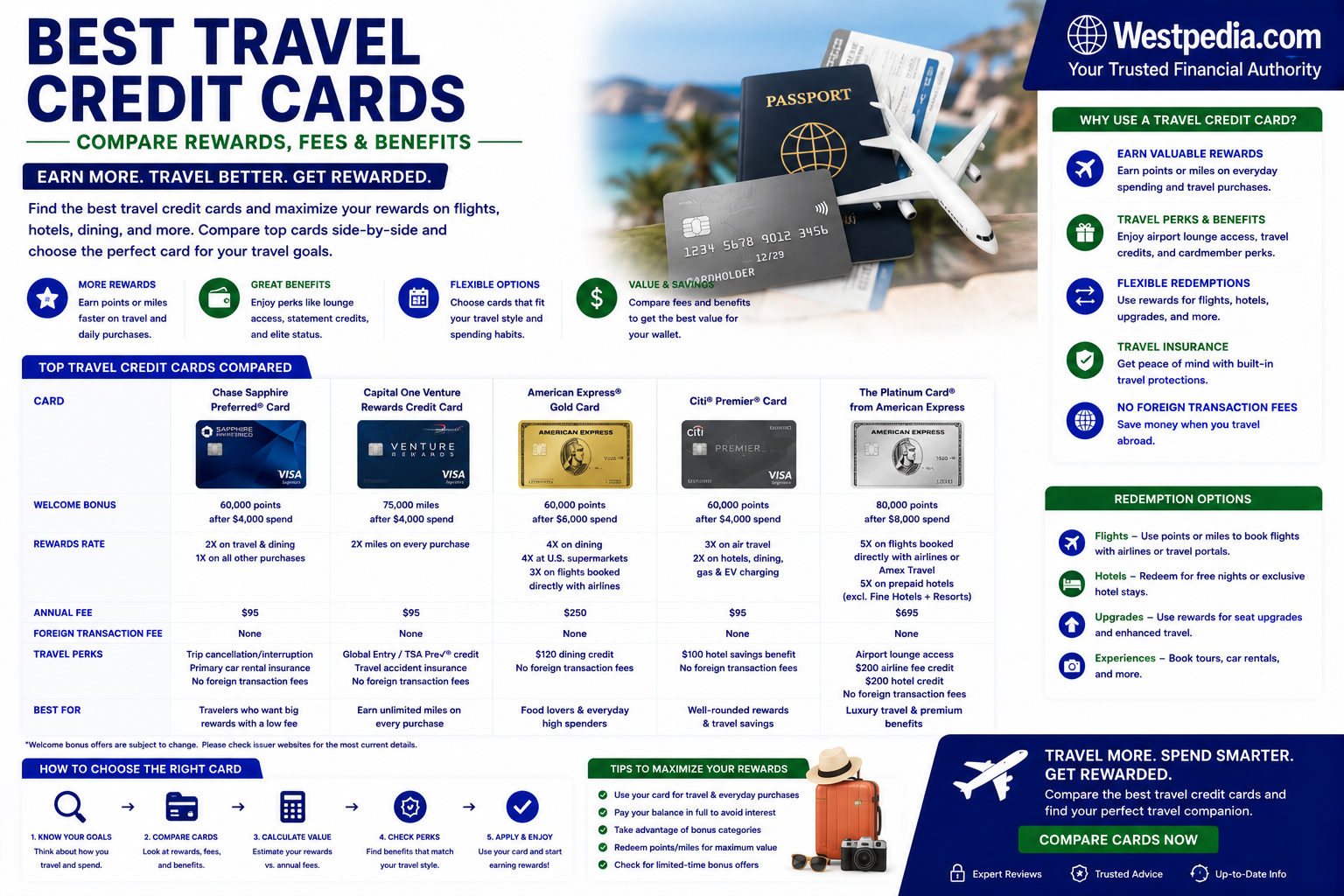
Travel Credit Cards Complete Guide
Travel credit cards generally provide rewards and benefits such as:
- Airline miles or flexible travel points
- Hotel rewards programs
- Welcome bonuses
- Airport lounge access
- No foreign transaction fees
- Travel insurance protections
- Statement credits for travel purchases
Frequent travelers often derive the most value from these cards, especially when rewards align with their travel habits.
Who Should Consider Travel Credit Cards?
Travel credit cards may be suitable for:
- Frequent business travelers.
- Vacation travelers who fly regularly.
- Consumers seeking airline or hotel rewards.
- Individuals who spend significantly on travel and dining.
- Cardholders who typically pay balances in full.
Consumers who carry balances month-to-month may benefit more from low interest credit cards because interest charges can offset rewards value.
What Financial Need Do Travel Credit Cards Solve?
Travel credit cards help consumers:
- Earn rewards on everyday purchases.
- Reduce travel expenses through redemptions.
- Access premium travel benefits.
- Simplify loyalty program participation.
- Receive travel protections and insurance benefits.
How Travel Credit Cards Work
Cardholders earn rewards when making eligible purchases. Rewards may accumulate as:
- Flexible points.
- Airline miles.
- Hotel loyalty points.
- Cash-equivalent travel credits.
Rewards can often be redeemed for:
- Flights.
- Hotel stays.
- Rental cars.
- Vacation packages.
- Statement credits.
- Gift cards.
Travel Credit Card Features Comparison Table
| Feature | Details |
|---|---|
| Rewards Currency | Points, miles, or travel credits |
| Welcome Bonus | Introductory rewards after qualifying spend |
| Annual Fee | Ranges from $0 to premium pricing |
| Foreign Transaction Fees | Often waived on travel cards |
| Lounge Access | Available on select premium cards |
| Travel Protections | Trip delay, baggage, and rental coverage |
| Redemption Flexibility | Varies by issuer and rewards ecosystem |
| Transfer Partners | Available on some premium products |
Rewards Breakdown
Travel rewards programs differ significantly among issuers. Consumers should evaluate both earning rates and redemption flexibility.
| Reward Category | Typical Earnings Rate |
|---|---|
| Travel Purchases | 2x–10x points or miles |
| Dining | 2x–5x points |
| General Purchases | 1x–2x points |
| Hotels | 3x–10x points |
| Airfare | 2x–5x points or miles |
Realistic Rewards Value Example
Assume a traveler spends:
- $6,000 annually on travel.
- $4,000 annually on dining.
- $10,000 on other purchases.
With average travel rewards rates, annual rewards value could potentially exceed several hundred dollars, depending on redemption choices and program rules.
Actual value varies considerably by issuer, redemption method, and travel patterns.
Fees and APR Explained
| Fee Type | Typical Range |
|---|---|
| Annual Fee | $0–$695+ |
| Purchase APR | Variable based on creditworthiness |
| Balance Transfer Fee | 3%–5% |
| Foreign Transaction Fee | 0%–3% |
| Cash Advance Fee | Issuer dependent |
Annual Fees
Premium travel cards often charge annual fees in exchange for enhanced benefits such as airport lounge access, travel credits, and premium insurance protections.
APR Considerations
Travel rewards can quickly lose value if balances accrue interest. Consumers who regularly carry balances should compare APRs carefully.
Foreign Transaction Fees
Many travel-focused products waive foreign transaction fees, making them attractive for international travel.
Travel Benefits and Protections
Depending on the card, benefits may include:
- Airport lounge access.
- Trip cancellation coverage.
- Trip delay reimbursement.
- Baggage delay insurance.
- Lost luggage protection.
- Rental car collision coverage.
- Global Entry or TSA PreCheck credits.
- Hotel elite status benefits.
Credit Score Requirements
| Credit Profile | Typical FICO Range | Approval Outlook |
|---|---|---|
| Poor | 300–579 | Limited travel card availability |
| Fair | 580–669 | Entry-level travel options |
| Good | 670–739 | Broad card availability |
| Very Good | 740–799 | Competitive premium options |
| Excellent | 800–850 | Access to top-tier travel products |
Issuer Comparison Table
| Issuer | Best For | Typical Credit Needed |
|---|---|---|
| Chase | Flexible travel rewards ecosystems | Good to Excellent |
| American Express | Premium travel experiences | Good to Excellent |
| Capital One | Straightforward travel rewards | Good to Excellent |
| Citi | Flexible points programs | Good to Excellent |
| Discover | Simple rewards structures | Fair to Good |
| Bank of America | Relationship banking rewards | Good to Excellent |
| Wells Fargo | General travel rewards cards | Good to Excellent |
Issuer Insights
Chase
Strengths: Flexible points transfers and broad travel partnerships.
Weaknesses: Competitive approval standards.
American Express
Strengths: Premium travel perks and lounge access.
Weaknesses: Higher annual fees on some products.
Capital One
Strengths: Simple redemption options and competitive travel benefits.
Weaknesses: Transfer partner availability varies.
Citi
Strengths: Flexible points redemption options.
Weaknesses: Benefits differ significantly by product.
Application and Underwriting Factors
- Credit score and history.
- Payment history.
- Debt-to-income ratio.
- Credit utilization ratio.
- Recent credit inquiries.
- Income verification.
- Length of credit history.
- Existing banking relationships.
Approval Process Explained
1. Application Submission
Consumers submit personal and financial information.
2. Credit Review
Issuers review credit reports and repayment history.
3. Underwriting Assessment
Overall creditworthiness is evaluated.
4. Approval or Denial
Applicants may receive instant or delayed decisions.
5. Card Issuance Timeline
Approved applicants generally receive cards within several business days.
6. Activation Process
The card must be activated before earning rewards.
How to Maximize Travel Rewards
- Use cards for bonus spending categories.
- Redeem points strategically.
- Understand transfer partner options.
- Monitor annual fees versus benefits received.
- Pay balances in full to avoid interest charges.
Common Credit Card Mistakes
- Carrying balances and paying high interest.
- Ignoring annual fees.
- Redeeming rewards inefficiently.
- Failing to use included travel benefits.
- Applying for cards without reviewing eligibility requirements.
Benefits vs Risks
Benefits
- Travel rewards accumulation.
- Potential travel cost savings.
- Premium travel benefits.
- Purchase and travel protections.
- Flexible redemption options.
Risks
- Annual fees.
- High variable APRs.
- Overspending to earn rewards.
- Complex redemption programs.
- Potential debt accumulation.
Alternatives to Consider
- Cash back credit cards.
- Airline credit cards.
- Hotel credit cards.
- No annual fee credit cards.
- Low interest credit cards.
Expert Considerations
The best travel credit card depends largely on spending habits, travel frequency, preferred airlines or hotel brands, and willingness to pay annual fees. Consumers should compare rewards value, redemption flexibility, travel protections, and total ownership costs before applying.
Approval is not guaranteed. Rewards programs, benefits, fees, and APRs may change without notice. Always review official issuer disclosures before submitting an application.
Frequently Asked Questions
1. What is a travel credit card?
A travel credit card earns points, miles, or rewards redeemable for travel expenses.
2. Are travel cards worth annual fees?
Value depends on individual travel habits and benefit usage.
3. What credit score is needed?
Many travel cards require good to excellent credit.
4. Can travel rewards expire?
Expiration policies vary by issuer and loyalty program.
5. Are foreign transaction fees common?
Many travel cards waive these fees, but not all products do.
6. Can I transfer travel points?
Some issuers allow transfers to airline and hotel partners.
7. Do travel cards include insurance?
Many offer travel-related protections, although coverage varies.
8. Does applying affect credit scores?
Applications often generate hard credit inquiries.
9. Can I earn rewards on everyday purchases?
Yes, most travel cards reward eligible purchases.
10. Is approval guaranteed with excellent credit?
No. Issuers evaluate multiple underwriting factors.
11. Should I choose points or airline miles?
The decision depends on travel preferences and redemption flexibility needs.
12. Can travel rewards be redeemed for cash?
Some programs allow cash-equivalent redemptions.