
Property tax reduction refers to legal methods that may lower property tax obligations through exemptions, assessment appeals, valuation corrections, or tax relief programs. It primarily affects homeowners, retirees, veterans, and property investors. Eligibility and savings opportunities vary by jurisdiction, making it important to verify local requirements, deadlines, and documentation before applying for relief.
Property Tax Reduction Complete Guide
Property tax reduction involves lawful strategies that may decrease the amount of property taxes owed on residential, commercial, or investment real estate. Property owners may qualify for reductions through exemptions, assessment appeals, abatements, deferrals, or other local tax relief programs.
Because property taxes are generally based on assessed property values and local tax rates, ensuring that assessments are accurate can significantly affect annual tax obligations.
This guide explains how property tax reduction works, eligibility requirements, available relief programs, compliance considerations, and common mistakes property owners should avoid.
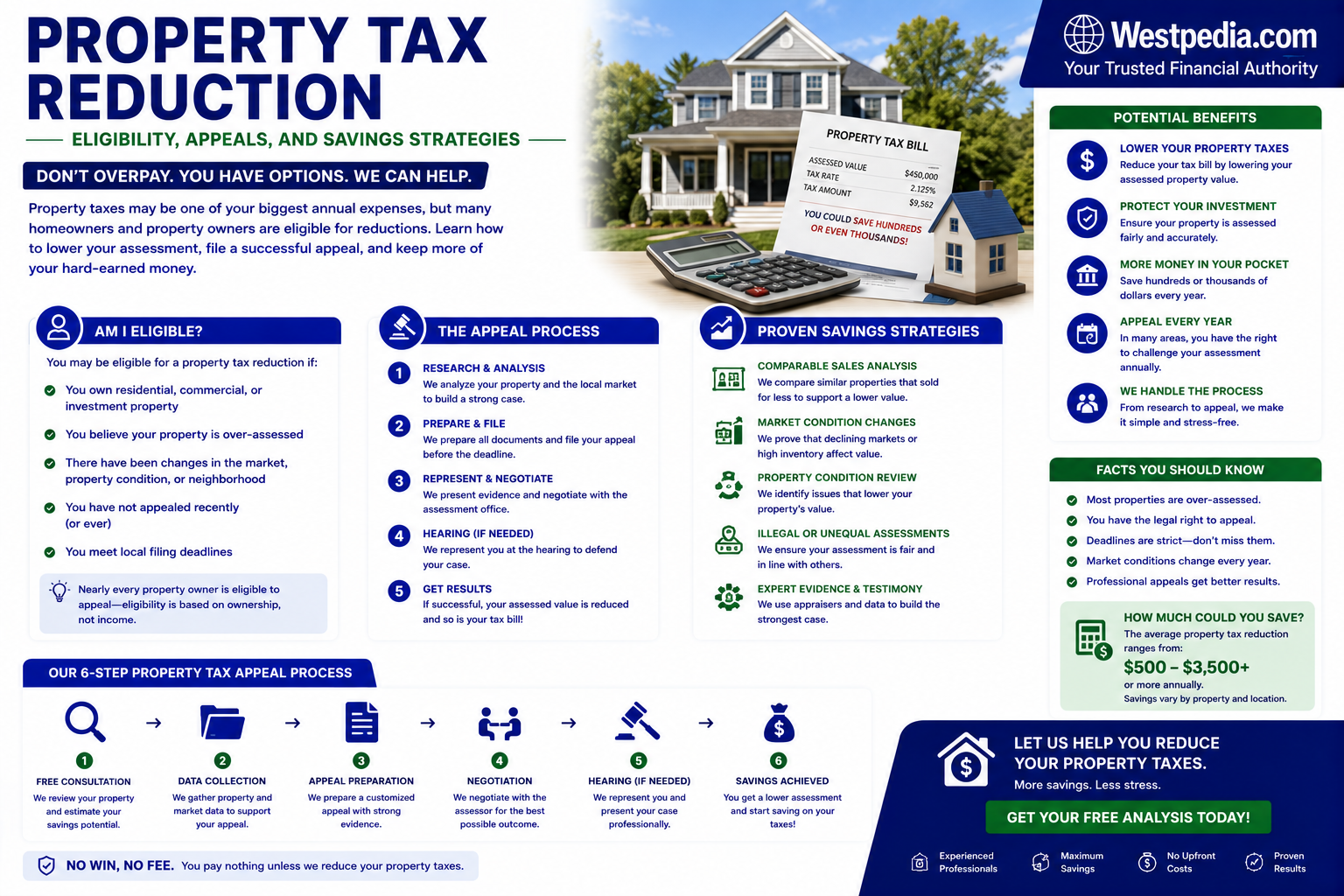
What Tax Issue Does Property Tax Reduction Address?
Property owners sometimes believe their assessed property value exceeds market value or that they qualify for exemptions they have not claimed.
Common taxpayer concerns include:
- Rapid increases in assessed values
- Rising annual property tax bills
- Unclaimed exemptions
- Incorrect property assessments
- Uncertainty regarding appeal procedures
- Understanding local tax relief programs
Property tax reduction strategies help property owners identify legitimate opportunities to reduce tax liabilities while maintaining compliance with local tax laws.
Who Is Affected?
- Homeowners
- Retirees
- Veterans
- Disabled individuals
- Real estate investors
- Landlords
- Owners of commercial properties
- Owners of agricultural property
- High-value property owners
How Property Tax Reduction Works
Property taxes are generally calculated by multiplying a property’s assessed value by the applicable local tax rate.
Tax reduction opportunities may include:
- Homestead exemptions
- Senior citizen exemptions
- Veteran exemptions
- Disability-related exemptions
- Agricultural use valuation programs
- Property assessment appeals
- Property tax deferral programs
- Tax abatements
Availability depends entirely on state and local laws.
Eligibility Requirements for Property Tax Reduction
| Requirement | Details |
|---|---|
| Property Ownership | The applicant generally must own the property. |
| Primary Residence Status | Some programs require owner occupancy. |
| Age Requirement | Senior programs may impose minimum age requirements. |
| Income Limits | Certain relief programs may impose income restrictions. |
| Residency Rules | Applicants may need to meet local residency requirements. |
| Supporting Documentation | Proof of ownership and eligibility is typically required. |
Eligible, Partially Eligible, and Ineligible Taxpayers
Eligible Property Owners
- Homeowners qualifying for homestead benefits
- Senior citizens meeting local requirements
- Eligible veterans
- Individuals qualifying for disability exemptions
- Agricultural property owners meeting use requirements
Partially Eligible Property Owners
- Owners of mixed-use properties
- Owners with partial residency status
- Taxpayers subject to income-based limitations
Potentially Ineligible Situations
- Investment properties excluded from relief programs
- Applicants missing filing deadlines
- Property owners unable to provide documentation
- Properties failing program requirements
Property Tax Savings Opportunities
Potential property tax reduction opportunities may include:
- Claiming available exemptions
- Correcting inaccurate assessments
- Appealing assessed values
- Participating in tax deferral programs
- Reviewing classification errors
- Applying for local tax relief initiatives
No reduction is guaranteed, and qualification requirements vary by jurisdiction.
Property Assessment Appeal Process
If a property owner believes an assessment is inaccurate, many jurisdictions allow formal appeals.
The appeal process often involves:
- Reviewing the assessment notice.
- Comparing similar property values.
- Collecting supporting evidence.
- Submitting an appeal application.
- Participating in hearings if required.
- Awaiting a decision from the assessment authority.
Example Property Tax Calculation
Educational Example Only
Assume:
- Assessed property value: $300,000
- Local tax rate: 1.5%
Estimated annual property tax:
$300,000 × 1.5% = $4,500
If a qualifying exemption reduces taxable value by $25,000:
Revised taxable value = $275,000
$275,000 × 1.5% = $4,125
Actual tax calculations depend on local rules and assessment methods.
Tax Impact Table
| Scenario | Potential Outcome |
|---|---|
| Homeowner qualifies for homestead exemption | Taxable value may decrease. |
| Assessment appeal succeeds | Property taxes may be reduced. |
| Assessment records contain errors | Corrections could affect tax liability. |
| Senior citizen qualifies for relief | Additional benefits may apply. |
| Appeal lacks supporting evidence | Reduction request may be denied. |
Deductions vs Credits
| Feature | Deduction | Credit |
|---|---|---|
| How It Works | Reduces taxable income | Directly reduces tax liability |
| Typical Property Tax Use | May apply on income tax returns | May apply under local relief programs |
| Potential Benefit | Depends on tax rate | Often dollar-for-dollar |
| Eligibility | Varies by tax law | Program specific |
| Documentation | Usually required | Usually required |
Compliance Requirements
Property owners seeking tax reductions should maintain complete documentation.
Common Documentation Requirements
- Property ownership records
- Assessment notices
- Income documentation when applicable
- Residency verification
- Veteran or disability documentation where applicable
- Comparable property data for appeals
Reporting Responsibilities
- Submit accurate applications
- Report changes affecting eligibility
- Respond to requests for information
- Retain supporting records
Property Tax Deadlines and Timing Considerations
Deadlines for exemptions, appeals, abatements, and relief applications vary by jurisdiction.
Property owners should monitor:
- Assessment notice dates
- Appeal filing deadlines
- Exemption application deadlines
- Tax payment due dates
- Renewal requirements
Missing deadlines may limit eligibility for available relief.
Tax Software and Service Comparison
| Provider | Best For | Pricing Level | Complexity |
|---|---|---|---|
| TurboTax | Homeowners with itemized deductions | Higher | Moderate to advanced |
| H&R Block | Taxpayer assistance and support | Moderate to higher | Moderate to advanced |
| TaxAct | Cost-conscious homeowners | Moderate | Moderate |
| FreeTaxUSA | Budget-focused taxpayers | Lower | Simple to moderate |
| Cash App Taxes | Eligible simpler tax situations | Lower | Simple |
Risk and Audit Considerations
Common issues include:
- Missing application deadlines
- Incomplete documentation
- Claiming unavailable exemptions
- Failure to report eligibility changes
- Incorrect property classifications
Maintaining accurate records can help support exemption or appeal claims.
Business and Investment Property Considerations
Owners of rental, commercial, and investment properties may encounter additional property tax rules.
Considerations include:
- Business use classifications
- Rental property tax treatment
- Depreciation implications
- Capital gains considerations upon sale
- Local commercial property tax rules
State and Local Tax Rules
Property tax laws vary significantly by state, county, municipality, and taxing authority.
Property owners should independently verify:
- Exemption availability
- Appeal procedures
- Assessment methods
- Documentation requirements
- Applicable deadlines
Frequently Asked Questions
1. What is property tax reduction?
It refers to lawful methods that may lower property tax obligations.
2. Can all homeowners qualify?
No. Eligibility depends on local laws and specific program requirements.
3. What is a homestead exemption?
It is a common property tax benefit available to qualifying owner-occupied residences.
4. Can I appeal my property assessment?
Many jurisdictions allow formal assessment appeals.
5. Does an appeal guarantee lower taxes?
No. Outcomes depend on evidence and local assessment procedures.
6. What documents are typically required?
Ownership records, assessment notices, and eligibility documentation are commonly required.
7. Are seniors eligible for additional relief?
Many jurisdictions offer senior-specific programs, subject to eligibility rules.
8. Do veterans receive property tax benefits?
Some jurisdictions provide veteran-related exemptions or relief programs.
9. Are rental properties eligible?
Eligibility varies depending on local laws and specific programs.
10. How often are properties reassessed?
Reassessment schedules vary by jurisdiction.
11. Can property tax reductions affect income taxes?
Certain property tax payments may have income tax implications depending on applicable law.
12. Should property owners consult professionals?
Complex situations may warrant assistance from qualified tax or real estate professionals.
Related Topics
- Business Tax Planning
- Tax Refund Services
- Real Estate Tax Deductions
- State Property Tax Rules
- Property Assessment Methods
- Investment Property Taxes
- Capital Gains Tax on Real Estate
- Tax Planning for Homeowners
- Local Tax Relief Programs
- Real Estate Recordkeeping
Important Tax Disclosure
This article is provided for educational purposes only and does not constitute tax, legal, or financial advice. Property tax laws and relief programs vary by jurisdiction and may change over time. Property owners should consult official local tax authorities and qualified professionals regarding eligibility, appeals, exemptions, and compliance requirements.