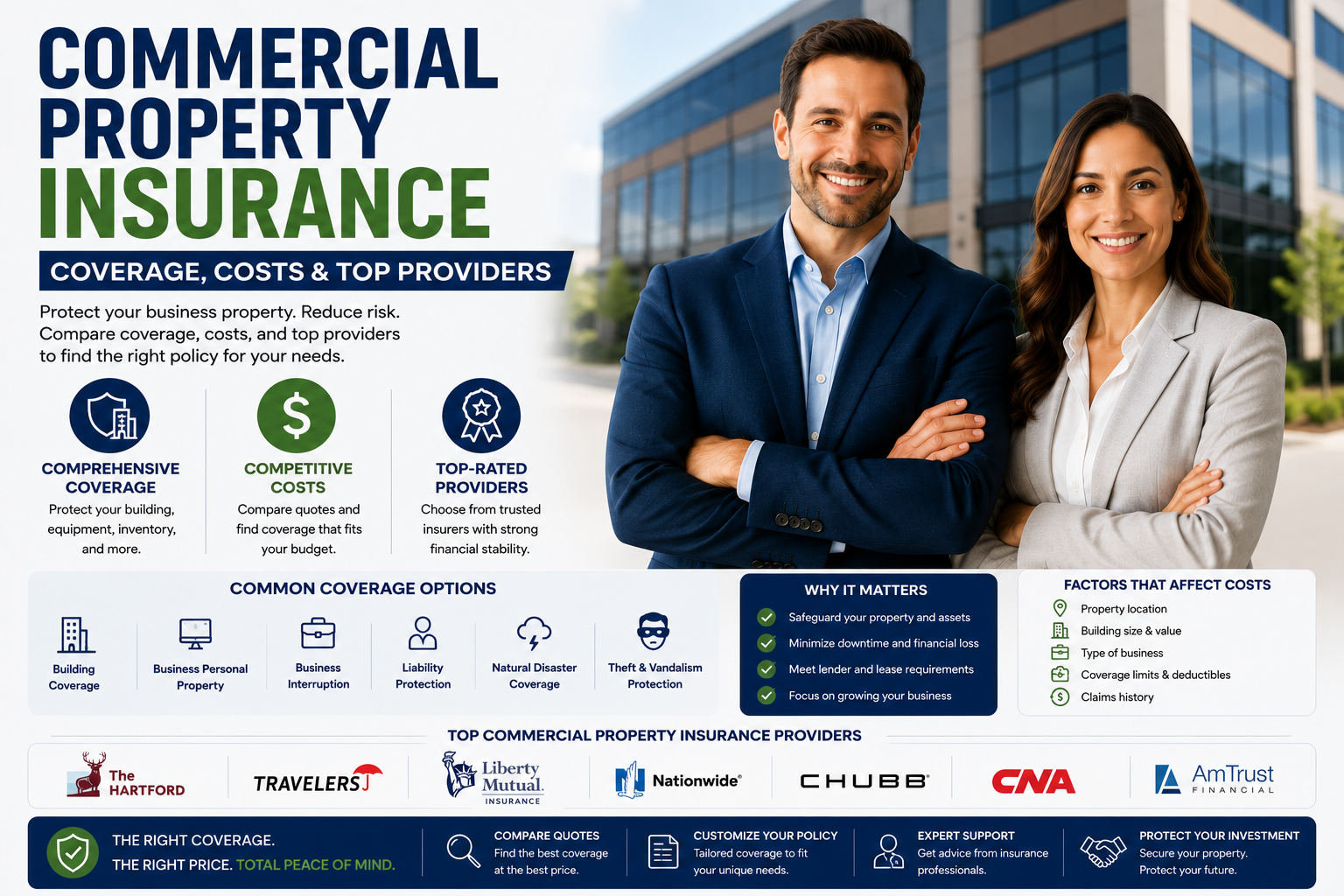
Commercial property insurance is one of the foundational coverages for businesses that own, lease, or operate from physical locations. Whether you run a retail store, office, warehouse, restaurant, or manufacturing facility, damage to business property can interrupt operations and create substantial financial losses.
This coverage helps businesses recover financially when covered events damage buildings, equipment, inventory, furniture, or other physical assets.
What Is Commercial Property Insurance?
Commercial property insurance protects business-owned physical assets against covered causes of loss, such as fire, theft, vandalism, windstorms, and certain weather-related events.

Coverage may apply to:
- Commercial buildings
- Office equipment
- Inventory and stock
- Furniture and fixtures
- Computers and technology
- Machinery and tools
- Outdoor signs
- Leasehold improvements
Coverage terms vary by insurer and policy form, making it important to review exclusions and limitations carefully.
Who Needs Commercial Property Insurance?
Most businesses that own or lease physical property should evaluate commercial property insurance.
Businesses commonly purchasing coverage include:
- Retail stores
- Professional offices
- Restaurants
- Manufacturers
- Medical practices
- Warehouses
- Technology firms
- Wholesalers
- Contractors
- Home-based businesses with business equipment
Why Commercial Property Insurance Matters
Unexpected losses can significantly disrupt operations. A fire, severe storm, or theft event could damage assets essential to generating revenue.
Commercial property insurance helps businesses:
- Replace damaged assets
- Resume operations faster
- Protect cash flow
- Meet lender or lease requirements
- Reduce financial uncertainty
Common Real-World Risk Scenarios
- A fire damages a retail storefront and inventory.
- Severe weather damages office equipment and furnishings.
- Burglars steal computers and specialized equipment.
- Vandals damage windows, signage, and business property.
- A burst pipe damages inventory stored in a warehouse.
Commercial Property Insurance Coverage Comparison
| Coverage Type | What It Covers | Recommended For |
|---|---|---|
| Building Coverage | Business-owned structures and permanent fixtures | Property owners |
| Business Personal Property | Equipment, furniture, inventory, electronics | Most businesses |
| Business Interruption | Lost income following covered losses | Revenue-generating businesses |
| Equipment Breakdown | Mechanical and electrical equipment failures | Equipment-dependent businesses |
| Ordinance or Law Coverage | Costs related to updated building codes | Older buildings |
| Crime Coverage | Theft, burglary, and employee dishonesty | Businesses handling valuable property |
What Commercial Property Insurance Typically Covers
- Fire and smoke damage
- Theft and burglary
- Vandalism
- Certain wind and hail damage
- Water damage from certain covered causes
- Explosion damage
- Damage caused by some civil disturbances
Common Exclusions
Many policies exclude or limit coverage for:
- Flood damage
- Earthquakes
- Normal wear and tear
- Intentional damage
- Equipment deterioration
- Certain cyber-related losses
- Acts of war
Businesses may need separate policies or endorsements for excluded risks.
Top Commercial Property Insurance Providers
| Provider | Best For | Coverage Strengths | Pricing Position | Potential Limitations |
|---|---|---|---|---|
| The Hartford | Small businesses | Broad property and BOP solutions | Competitive | Availability varies by state |
| Travelers | Growing businesses | Extensive commercial property expertise | Mid-range | Some coverages require customization |
| Chubb | Complex and high-value properties | Customizable protection and high limits | Premium | Higher pricing for some businesses |
| Hiscox | Small offices and professional firms | Flexible small business solutions | Competitive | Limited appetite for certain industries |
| Progressive Commercial | Bundled commercial solutions | Partner network for business coverage | Competitive | Coverage options may vary by partner carrier |
How Much Does Commercial Property Insurance Cost?
Premiums depend on numerous underwriting factors, including location, construction type, occupancy, and property values.
| Business Type | Estimated Monthly Premium Range | Risk Level |
|---|---|---|
| Professional Office | $40–$150+ | Low |
| Retail Store | $60–$300+ | Moderate |
| Restaurant | $100–$500+ | Moderate to High |
| Warehouse | $150–$1,000+ | High |
| Manufacturing Facility | $250–$3,000+ | High |
Factors That Affect Premiums
- Property location
- Building age and construction type
- Business industry classification
- Property replacement value
- Security systems
- Fire protection measures
- Claims history
- Coverage limits selected
- Deductible amount
- Business revenue
How Insurers Evaluate Commercial Property Risks
Underwriters analyze several factors before issuing coverage.
- Business operations
- NAICS industry classification
- Property condition
- Occupancy type
- Annual revenue
- Historical claims
- Safety and maintenance procedures
- Fire suppression systems
Understanding the Claims Process
- Report property damage immediately.
- Document damages with photographs and records.
- Protect property from additional damage when safe.
- Submit claim documentation to the insurer.
- An adjuster investigates the loss.
- The insurer evaluates coverage and settlement value.
- Covered claims proceed to payment or repair authorization.
Payout timelines vary depending on claim complexity and documentation completeness.
How Businesses Can Reduce Insurance Costs
- Install monitored security systems.
- Use fire alarms and sprinkler systems.
- Maintain buildings regularly.
- Bundle policies through a Business Owner’s Policy.
- Select appropriate deductibles.
- Review coverage annually.
- Implement documented safety procedures.
State Regulations and Compliance Considerations
Insurance requirements and regulatory standards vary by state. Lenders, landlords, and licensing agencies may require specific coverage limits or endorsements.
Businesses should review contractual obligations and local requirements when selecting coverage.
Common Mistakes Businesses Make
- Underinsuring buildings or equipment.
- Using outdated property valuations.
- Ignoring business interruption coverage.
- Failing to review exclusions.
- Not updating policies after expansion.
- Purchasing coverage based solely on price.
Expert Considerations Before Buying Coverage
Businesses should calculate replacement costs carefully, inventory all assets, evaluate operational risks, and compare multiple insurers before purchasing commercial property insurance.
Coverage limits should reflect current replacement values rather than original purchase prices.
Frequently Asked Questions
1. What does commercial property insurance cover?
It generally covers buildings, equipment, inventory, furniture, and other physical assets against covered losses.
2. Is commercial property insurance legally required?
Coverage is not usually mandated by law, but lenders and landlords often require it.
3. Does commercial property insurance cover floods?
Flood damage is typically excluded and may require separate coverage.
4. What is business personal property coverage?
It protects movable business assets such as equipment, furniture, inventory, and electronics.
5. Does property insurance cover lost income?
Business interruption coverage may reimburse lost income after covered losses.
6. How are premiums calculated?
Insurers consider location, property values, construction type, industry, and claims history.
7. Should tenants purchase commercial property insurance?
Yes. Tenants often need coverage for equipment, inventory, and leasehold improvements.
8. How often should coverage be reviewed?
Policies should typically be reviewed annually and after major business changes.
9. Can businesses bundle property coverage?
Many insurers offer bundled coverage through Business Owner’s Policies (BOPs).
10. What is replacement cost coverage?
Replacement cost coverage pays to replace damaged property without deducting depreciation, subject to policy terms.