
For many homeowners, their property represents one of their largest financial assets. As mortgage payments reduce the outstanding loan balance and property values increase over time, homeowners build equity that may be used to access financing when needed. A home equity loan is one of the most common ways to borrow against that equity while keeping the original mortgage in place.
Whether you’re planning a major home renovation, consolidating high-interest debt, covering educational expenses, or financing another large purchase, a home equity loan can provide access to substantial funds with predictable monthly payments. However, because your home serves as collateral, understanding the benefits, costs, risks, and qualification requirements is essential before applying.
This guide explains how home equity loans work, who they are designed for, common borrowing scenarios, potential risks, and the factors lenders consider when evaluating loan applications.
What Is a Home Equity Loan?
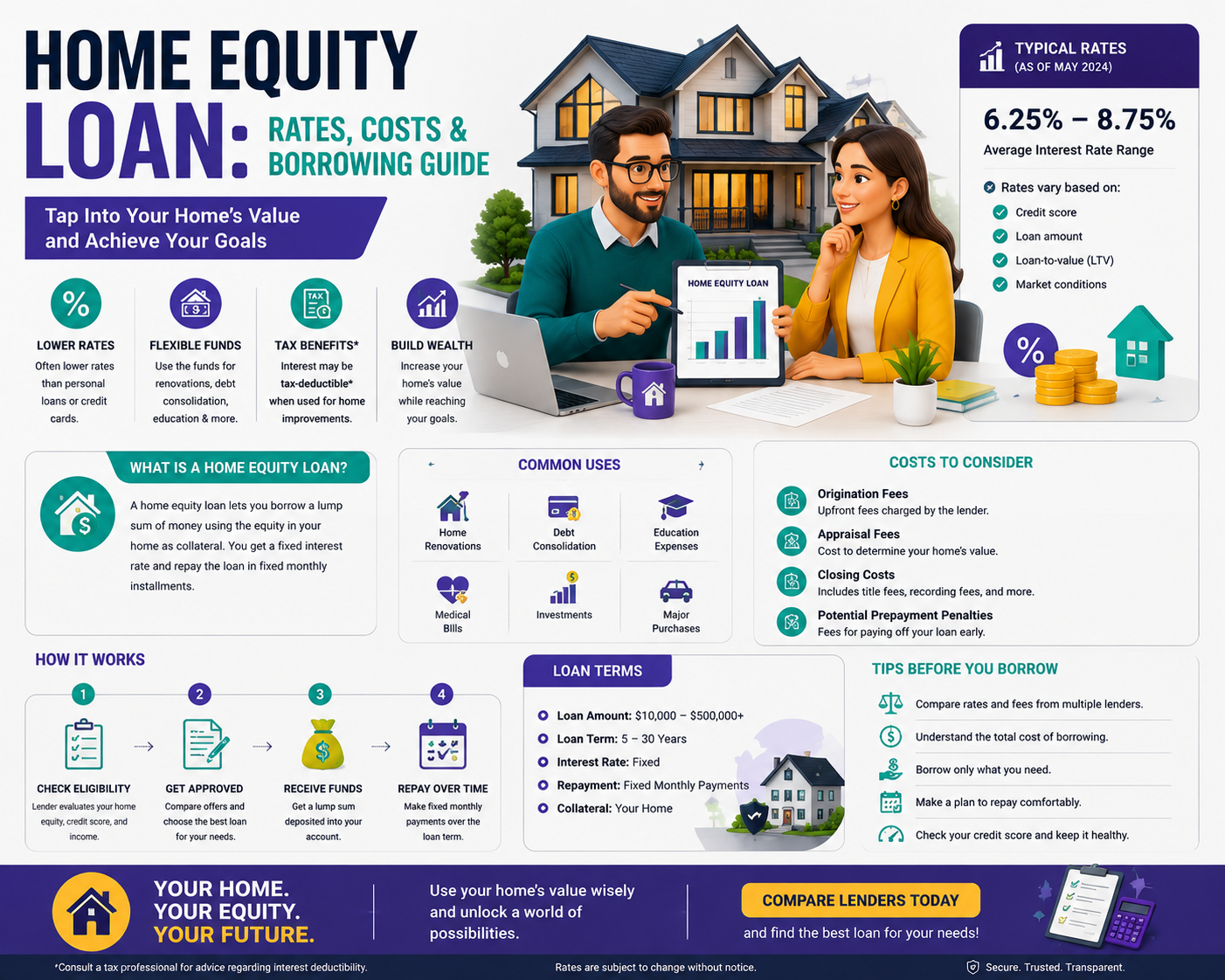
A home equity loan is a type of secured financing that allows homeowners to borrow money using the equity in their home as collateral. Equity is generally the difference between your home’s current market value and the remaining balance on your mortgage.
Unlike a revolving line of credit, a home equity loan provides borrowers with a one-time lump-sum payment. The loan is then repaid through fixed monthly installments over an agreed repayment period, often with a fixed interest rate.
Because the loan is secured by real estate, interest rates are often lower than those for unsecured borrowing options such as personal loans or credit cards. However, failing to repay the loan may put the property at risk of foreclosure.
How Does a Home Equity Loan Work?
When approved, the lender determines how much equity is available and establishes the maximum loan amount based on factors such as your home’s appraised value, outstanding mortgage balance, income, debt obligations, and credit profile.
Once the loan closes, you receive the approved amount as a lump sum. You then repay the loan through scheduled monthly payments consisting of principal and interest until the balance is fully repaid.
Unlike variable-rate financing, many home equity loans offer fixed interest rates, allowing borrowers to budget with predictable monthly payments throughout the life of the loan.
What Financial Problems Can a Home Equity Loan Solve?
A home equity loan can be an effective financing solution when used responsibly for significant expenses that may provide long-term value or help improve financial stability.
Common reasons homeowners consider this type of financing include:
- Major home renovations or remodeling projects
- Debt consolidation to replace higher-interest balances
- College or education expenses
- Medical bills not covered by insurance
- Large emergency expenses
- Business startup or expansion funding (where appropriate)
- Wedding or family event expenses
- Purchasing investment opportunities
- Replacing aging home systems such as roofing or HVAC
Borrowing against home equity may make financial sense when the funds are used for planned, manageable expenses and the borrower has a clear repayment strategy.
Who Should Consider a Home Equity Loan?
Home equity loans are generally intended for homeowners who have built sufficient equity, maintain stable income, and need access to a predictable lump-sum loan.
Typical borrower profiles include:
- Homeowners planning major renovations
- Borrowers consolidating high-interest debt
- Families paying education expenses
- Homeowners financing large medical costs
- Individuals seeking predictable fixed monthly payments
- Property owners with strong credit histories
- Borrowers with long-term financing needs
Because the home secures the loan, borrowers should be confident they can comfortably manage monthly repayments before taking on additional debt.
Benefits of a Home Equity Loan
For qualified borrowers, a home equity loan offers several advantages compared with some other financing options.
- Access to relatively large loan amounts based on available home equity.
- Fixed interest rates on many loan products.
- Predictable monthly payments.
- Long repayment terms that may lower monthly payment amounts.
- Potentially lower interest rates than unsecured loans.
- Suitable for one-time major expenses.
- May improve financial management when used for debt consolidation.
While these benefits can make home equity loans attractive, borrowers should carefully evaluate the total borrowing cost and their ability to repay over time.
Potential Risks to Consider
Using home equity to borrow money also involves important financial risks. Understanding these risks helps borrowers make informed decisions.
- Your home serves as collateral.
- Missed payments could result in foreclosure.
- Closing costs and lender fees may increase total borrowing expenses.
- Borrowing reduces available home equity.
- Property values may fluctuate over time.
- Taking on unnecessary debt can affect long-term financial flexibility.
Responsible borrowing involves balancing immediate financing needs with long-term financial goals.
Real-World Borrowing Scenarios
Scenario 1: Home Renovation
A homeowner has built substantial equity and plans a kitchen renovation that may increase both comfort and property value. Rather than using high-interest credit cards, they choose a home equity loan with fixed monthly payments.
Scenario 2: Debt Consolidation
A borrower has multiple high-interest credit card balances. By consolidating eligible debts into a home equity loan, they simplify repayment into one monthly payment. Whether this reduces overall borrowing costs depends on the interest rate, loan term, and total fees.
Scenario 3: Education Expenses
Parents may use home equity financing to help cover higher education costs when they determine it fits their overall financial plan and repayment capacity.
Scenario 4: Unexpected Medical Bills
Major healthcare expenses can strain household finances. A home equity loan may provide access to needed funds while offering predictable repayment terms, although borrowers should carefully evaluate long-term affordability.
Home Equity Loan vs. Personal Loan
Although both products provide access to financing, they differ in several important ways.
- Collateral: A home equity loan is secured by your home, while most personal loans are unsecured.
- Interest Rates: Home equity loans often have lower interest rates because they are secured.
- Loan Amounts: Home equity loans may provide larger borrowing limits depending on available equity.
- Approval Requirements: Home equity loans require sufficient home equity and property evaluation.
- Risk: Defaulting on a home equity loan may place your property at risk.
Choosing between these options depends on your financial situation, borrowing needs, available collateral, and risk tolerance.
Key Takeaways Before Applying
- Understand how much equity you have available.
- Estimate your monthly repayment comfortably within your budget.
- Compare multiple lenders instead of accepting the first offer.
- Review interest rates, fees, and repayment terms carefully.
- Borrow only what you reasonably need.
- Consider the long-term impact on your overall financial health.
Types of Home Equity Financing Options
Homeowners have several ways to access property equity depending on their financial goals, repayment preferences, and borrowing needs. Each option has different features, costs, and risk considerations.
1. Fixed-Rate Home Equity Loan
A traditional home equity loan provides a lump-sum payment with a fixed interest rate and predictable monthly payments. This option is commonly used for large, one-time expenses such as renovations, debt consolidation, or major financial needs.
Best suited for:
- Borrowers who know the exact amount they need.
- Homeowners who prefer predictable payments.
- Long-term financing projects.
2. Home Equity Line of Credit (HELOC)
A HELOC is a revolving credit option that allows homeowners to borrow funds as needed up to an approved credit limit. Unlike a fixed home equity loan, HELOC interest rates are often variable.
Best suited for:
- Projects with uncertain costs.
- Home renovations completed over time.
- Borrowers who want flexible access to funds.
3. Cash-Out Refinance
A cash-out refinance replaces your existing mortgage with a new, larger mortgage and allows you to receive the difference in cash. This option may be useful when current mortgage terms are favorable compared with available alternatives.
4. Personal Loan Alternative
A personal loan does not require home collateral in most cases. It may provide faster funding but often comes with different interest rates, loan limits, and repayment terms.
Home Equity Loan vs HELOC vs Cash-Out Refinance Comparison
| Feature | Home Equity Loan | HELOC | Cash-Out Refinance |
|---|---|---|---|
| Loan Structure | Lump-sum payment | Revolving credit line | New mortgage loan |
| Interest Rate | Usually fixed | Often variable | Usually fixed or adjustable |
| Payment Predictability | High | Changes with rates | Depends on mortgage terms |
| Best For | Large planned expenses | Ongoing borrowing needs | Replacing mortgage and accessing equity |
| Closing Costs | Possible | Possible | Commonly applies |
| Home Used as Collateral | Yes | Yes | Yes |
Home Equity Loan Cost and Rate Information
The cost of a home equity loan depends on several borrower and market factors. Unlike unsecured financing, lenders evaluate both the homeowner’s financial profile and the value of the property securing the loan.
Typical costs may include:
- Interest charges
- Loan origination fees
- Appraisal fees
- Closing costs
- Title search fees
- Documentation fees
- Potential annual fees (depending on lender)
Exact costs vary by lender, location, loan size, credit profile, and market conditions.
Estimated Home Equity Loan Rates and Terms
| Loan Feature | Typical Range | Factors Affecting Pricing |
|---|---|---|
| APR | Approximately 6%–12%+ depending on market conditions | Credit score, equity, income, lender policies |
| Loan Amount | Often $10,000 to several hundred thousand dollars | Home value, mortgage balance, lender limits |
| Repayment Term | Typically 5–30 years | Lender program and borrower preference |
| Monthly Payment | Varies based on amount, rate, and term | Interest rate and repayment period |
| Origination Fees | May range from 0%–2% or more | Lender structure and loan complexity |
Note: Rates and fees are examples only. Actual loan pricing changes based on economic conditions, lender requirements, borrower qualifications, and location.
How Much Can You Borrow With a Home Equity Loan?
The amount you can borrow depends mainly on your available home equity and the lender’s maximum loan-to-value (LTV) requirements.
A common calculation is:
Home Value – Remaining Mortgage Balance = Available Equity
For example, if a home is valued at $400,000 and the remaining mortgage balance is $220,000, the homeowner may have approximately $180,000 in equity. However, lenders generally do not allow borrowers to access the entire equity amount.
Many lenders consider factors such as:
- Current property value
- Existing mortgage balance
- Creditworthiness
- Income stability
- Debt obligations
- Loan purpose
Eligibility Requirements for a Home Equity Loan
Lenders evaluate multiple aspects of a borrower’s financial profile before approving a home equity loan application.
Common qualification factors include:
- Sufficient home equity
- Stable income
- Acceptable credit score
- Manageable debt-to-income ratio
- Reliable employment history
- Positive payment history
- Property evaluation approval
Meeting minimum requirements does not guarantee approval because every lender uses different underwriting standards.
How Lenders Evaluate Home Equity Loan Applications
Home equity loan underwriting focuses on determining whether the borrower can comfortably repay the loan while assessing the value and condition of the collateral property.
1. Credit Score
Your credit score helps lenders evaluate borrowing reliability. Higher scores may improve access to more competitive loan terms, although lenders consider the complete financial profile.
2. Debt-to-Income Ratio (DTI)
DTI measures how much of your monthly income goes toward existing debt payments. A lower DTI generally indicates stronger repayment capacity.
3. Income Verification
Lenders typically review employment income, self-employment earnings, tax documents, bank statements, or other proof of repayment ability.
4. Employment History
Stable employment history can help demonstrate consistent income reliability.
5. Home Value Assessment
An appraisal or valuation process helps determine the property’s current market value and available equity.
6. Existing Debt Obligations
Lenders review mortgages, credit cards, auto loans, and other financial commitments to evaluate overall affordability.
Factors That Influence Home Equity Loan Rates
Two homeowners applying for similar loan amounts may receive different offers because lenders consider individual risk factors.
- Credit Score: Stronger credit profiles may qualify for better pricing.
- Loan Amount: Larger loans may involve different risk calculations.
- Loan-to-Value Ratio: More available equity may improve eligibility.
- Income Level: Stable income supports repayment confidence.
- Debt-to-Income Ratio: Lower existing debt may strengthen applications.
- Loan Term: Longer repayment periods affect total interest costs.
- Location: Lending availability and regulations vary by state.
State Regulations and Lending Considerations
Home equity lending rules can vary depending on state regulations, consumer protection laws, and lender licensing requirements. Some loan products may not be available in every location.
Borrowers should consider:
- State-specific lending rules
- Consumer protection requirements
- Property-related regulations
- Disclosure requirements
- Available lender options in their area
Reviewing loan documents carefully and understanding applicable regulations can help borrowers make informed financing decisions.
Comparing Major Home Equity Loan Lenders
Choosing the right home equity loan lender requires more than comparing advertised interest rates. Borrowers should evaluate lender reputation, loan terms, eligibility requirements, fees, customer service, digital tools, and overall suitability for their financial situation.
Different lenders serve different borrower profiles. Some focus on traditional banking relationships, while others specialize in online lending, flexible underwriting, or streamlined application experiences.
The following comparison provides a general overview of major lenders and their positioning. Availability, rates, and loan terms vary by state, borrower qualifications, and current lending conditions.
Lender Comparison Table
| Lender | Best For | Strengths | Eligibility Considerations | Potential Limitations |
|---|---|---|---|---|
| Bank of America | Homeowners seeking traditional banking services | Strong banking relationship options, established mortgage experience | Credit profile, income verification, property value | Loan availability and terms vary by location |
| Wells Fargo | Borrowers interested in established financial institutions | Large banking infrastructure and mortgage experience | Standard credit and property evaluation requirements | Product availability may change over time |
| Chase | Existing bank customers seeking integrated services | Convenient banking relationship management | Income, credit history, home equity assessment | Not every borrower may qualify for preferred terms |
| U.S. Bank | Borrowers wanting traditional lending options | Home lending experience and multiple financial products | Creditworthiness and repayment ability | Terms depend on borrower profile |
| SoFi | Digitally focused borrowers | Online application experience and consumer finance products | Strong credit and financial profile may be preferred | Not all loan products are available to all borrowers |
| LendingClub | Online lending customers | Digital loan experience and simplified processes | Credit history and income review | Product availability differs by state |
| Upstart | Borrowers seeking technology-based lending evaluation | Uses alternative data factors in some lending products | Income, credit history, and other risk factors | Home equity loan availability may vary |
| LightStream | Strong-credit borrowers seeking unsecured financing alternatives | Competitive personal loan options for qualified borrowers | Strong credit profile often important | Not a traditional home equity lender |
How to Choose the Right Home Equity Loan Lender
The best lender depends on your financial goals, not simply the lowest advertised rate. A borrower with excellent credit and significant equity may have different priorities than someone focused on flexible qualification requirements.
Consider these factors when comparing lenders:
- Interest rate and APR
- Total borrowing costs
- Loan-to-value requirements
- Minimum credit score expectations
- Available loan amounts
- Repayment terms
- Closing costs and fees
- Customer service reputation
- Online account management tools
- Speed of application processing
Comparing multiple offers allows borrowers to understand available options before committing to a long-term financial obligation.
Home Equity Loan Application Process
The application process generally involves several steps. Understanding each stage can help borrowers prepare documents and avoid unnecessary delays.
Step 1: Review Your Financial Position
Before applying, evaluate your home’s estimated value, remaining mortgage balance, credit profile, income stability, and current debts.
Important questions include:
- How much equity do I have?
- Can I comfortably afford another monthly payment?
- How much money do I actually need?
- Will this loan improve or create financial pressure?
Step 2: Prequalification
Many lenders allow borrowers to check potential eligibility through a prequalification process. This may provide an estimate of possible loan options without requiring a full application.
Prequalification does not guarantee approval because lenders typically conduct a complete review before making a final decision.
Step 3: Submit the Application
During the formal application, borrowers typically provide:
- Personal identification information
- Income documentation
- Employment details
- Mortgage information
- Property details
- Requested loan amount
- Purpose of borrowing
Step 4: Documentation Review and Property Evaluation
The lender reviews financial documents and evaluates the property securing the loan.
This stage may involve:
- Credit report review
- Income verification
- Debt analysis
- Property appraisal
- Title review
Step 5: Underwriting Decision
During underwriting, the lender analyzes the complete risk profile of the application.
Underwriters generally evaluate:
- Credit history
- Payment behavior
- Debt-to-income ratio
- Income stability
- Employment status
- Property value
- Loan amount requested
- Existing mortgage obligations
The lender then determines whether the application meets their approval standards.
Step 6: Closing and Funding
If approved, borrowers review and sign final loan documents. After closing requirements are completed, funds are typically provided according to lender procedures.
Funding timelines vary depending on lender processing, documentation requirements, property evaluation, and borrower responsiveness.
How to Improve Your Chances of Approval
Although no strategy guarantees approval, improving your financial profile before applying may strengthen your application.
Improve Your Credit Score
- Pay bills on time.
- Reduce outstanding credit card balances.
- Avoid unnecessary new credit applications.
- Review credit reports for errors.
Reduce Debt-to-Income Ratio
Lenders prefer borrowers who demonstrate manageable debt compared with their income.
Strategies include:
- Paying down existing balances.
- Avoiding additional debt before applying.
- Increasing stable income where possible.
Maintain Strong Financial Records
Organized financial documentation can make the application process smoother.
Keep records of:
- Income statements
- Tax documents
- Mortgage statements
- Bank records
- Property information
Responsible Borrowing Strategies
A home equity loan can be a useful financial tool, but borrowers should use it carefully because the loan is secured by their property.
Responsible borrowing practices include:
- Borrow only the amount needed.
- Create a repayment plan before accepting funds.
- Consider future income stability.
- Avoid using home equity for unnecessary spending.
- Maintain emergency savings when possible.
- Understand the total interest cost.
- Review all fees before signing documents.
Common Home Equity Loan Mistakes
- Choosing a lender based only on the lowest rate.
- Ignoring closing costs and fees.
- Borrowing more than necessary.
- Failing to compare multiple lenders.
- Not understanding variable-rate alternatives.
- Ignoring the risk of using home collateral.
- Skipping a budget review before borrowing.
- Not reading loan terms carefully.
Expert Considerations Before Taking a Home Equity Loan
A home equity loan can provide access to significant funds, but it should be evaluated as a long-term financial decision rather than a quick source of cash. Because your home secures the loan, borrowers should carefully analyze both the benefits and potential consequences before moving forward.
Before applying, consider the following questions:
- Is this expense necessary or could it be delayed?
- Will the loan improve my overall financial position?
- Can I comfortably afford the monthly payment?
- How will this loan affect my future financial flexibility?
- Am I comparing multiple lenders and loan options?
- Do I understand all fees, interest charges, and repayment terms?
Making an informed borrowing decision requires evaluating your current financial situation, future goals, and ability to manage additional debt.
When Does a Home Equity Loan Make Financial Sense?
A home equity loan may be a reasonable option when the borrowed funds serve a clear purpose and the repayment plan fits comfortably within your budget.
Situations where homeowners may consider this financing include:
- Home Improvements: Renovations that improve functionality or potentially increase property value.
- Debt Consolidation: Replacing higher-interest debt with a lower-cost secured loan when financially appropriate.
- Major Planned Expenses: Large costs with predictable repayment plans.
- Investment Opportunities: Certain financial opportunities where risks and returns are carefully evaluated.
- Emergency Expenses: Significant unexpected costs when other options are limited.
However, using home equity for unnecessary purchases or expenses without a repayment strategy may create financial stress.
When Should You Avoid a Home Equity Loan?
Although home equity financing can be useful, it may not be appropriate in every situation.
Borrowers should be cautious if:
- Income is unstable.
- Existing debt levels are already difficult to manage.
- The monthly payment would strain the household budget.
- The loan is being used for short-term spending habits.
- There is uncertainty about future employment.
- The borrower has limited emergency savings.
Because the home serves as collateral, borrowers should carefully consider the consequences of missed payments.
Strategies to Manage Home Equity Loan Repayment
Successful repayment requires planning beyond the initial approval. A strong repayment strategy can reduce financial stress and help maintain long-term stability.
1. Create a Realistic Monthly Budget
Include the new loan payment alongside mortgage payments, utilities, insurance, taxes, and other financial obligations.
2. Avoid Adding Unnecessary Debt
Taking additional loans or increasing credit card balances while repaying a home equity loan can make financial management more difficult.
3. Consider Extra Payments When Possible
If your loan terms allow it, additional payments may reduce the repayment period and total interest costs.
4. Maintain Emergency Savings
Unexpected expenses can create repayment challenges. Maintaining savings can provide additional financial protection.
5. Review Your Loan Annually
Changes in income, expenses, or financial goals may require adjustments to your overall borrowing strategy.
Home Equity Loan Refinancing Considerations
Some borrowers consider refinancing their home equity loan if market conditions, financial circumstances, or repayment goals change.
Potential reasons to explore refinancing may include:
- Obtaining a different interest rate.
- Changing repayment terms.
- Lowering monthly payments.
- Combining multiple debts.
- Adjusting loan structure.
However, refinancing may involve new fees, closing costs, and extended repayment periods. Borrowers should compare the total cost before making a decision.
Frequently Asked Questions (FAQs)
1. What credit score is needed for a home equity loan?
Credit requirements vary by lender. Many lenders prefer borrowers with good credit profiles, but approval depends on factors including income, equity, debt levels, and overall financial history.
2. How much equity do I need for a home equity loan?
The required equity amount depends on lender guidelines, property value, existing mortgage balance, and acceptable loan-to-value limits.
3. Is a home equity loan better than a personal loan?
It depends on the borrower’s situation. Home equity loans may offer lower rates because they are secured, but they place the home at risk if payments are not made.
4. Are home equity loan interest rates fixed?
Many home equity loans offer fixed interest rates, meaning monthly payments remain predictable. However, terms vary by lender and product.
5. How long does it take to get a home equity loan?
The timeline varies depending on the lender, documentation requirements, property evaluation, and underwriting process. Some applications may take weeks from application to funding.
6. Can I use a home equity loan for anything?
Many lenders allow borrowers to use funds for various purposes, but borrowers should consider whether the expense supports their long-term financial goals.
7. Does a home equity loan affect my mortgage?
A home equity loan is usually a separate loan secured by your property and does not replace your existing mortgage.
8. What happens if I cannot repay a home equity loan?
Because the loan is secured by your home, missed payments may create serious financial consequences, including possible foreclosure depending on circumstances and applicable laws.
9. Are there closing costs on a home equity loan?
Some lenders charge closing costs or fees, while others may offer different pricing structures. Borrowers should review all costs before accepting an offer.
10. Can I get a home equity loan with bad credit?
Some lenders may consider borrowers with less-than-perfect credit, but approval depends on the complete financial profile, available equity, income, and lender requirements.
11. What is the difference between a home equity loan and HELOC?
A home equity loan provides a lump sum with scheduled repayment, while a HELOC provides access to a revolving credit line that can typically be used as needed.
12. Can I pay off a home equity loan early?
Many loans allow early repayment, but borrowers should check whether any prepayment penalties or restrictions apply.
13. Do home equity loans have tax benefits?
Tax treatment depends on how loan funds are used and current tax regulations. Borrowers should consult a qualified tax professional for personal guidance.
Final Thoughts
A home equity loan can be a valuable financing option for homeowners who need access to funds and have sufficient equity in their property. With fixed payments, potentially competitive interest rates, and access to larger loan amounts, it can help finance major expenses when used responsibly.
However, borrowing against your home requires careful planning. The right decision depends on your financial goals, income stability, credit profile, repayment ability, and understanding of loan terms.
Before applying, compare multiple lenders, review interest rates and fees, understand repayment obligations, and evaluate whether the loan supports your long-term financial strategy.
Responsible borrowing is not only about getting approved — it is about choosing financing that fits your overall financial health.