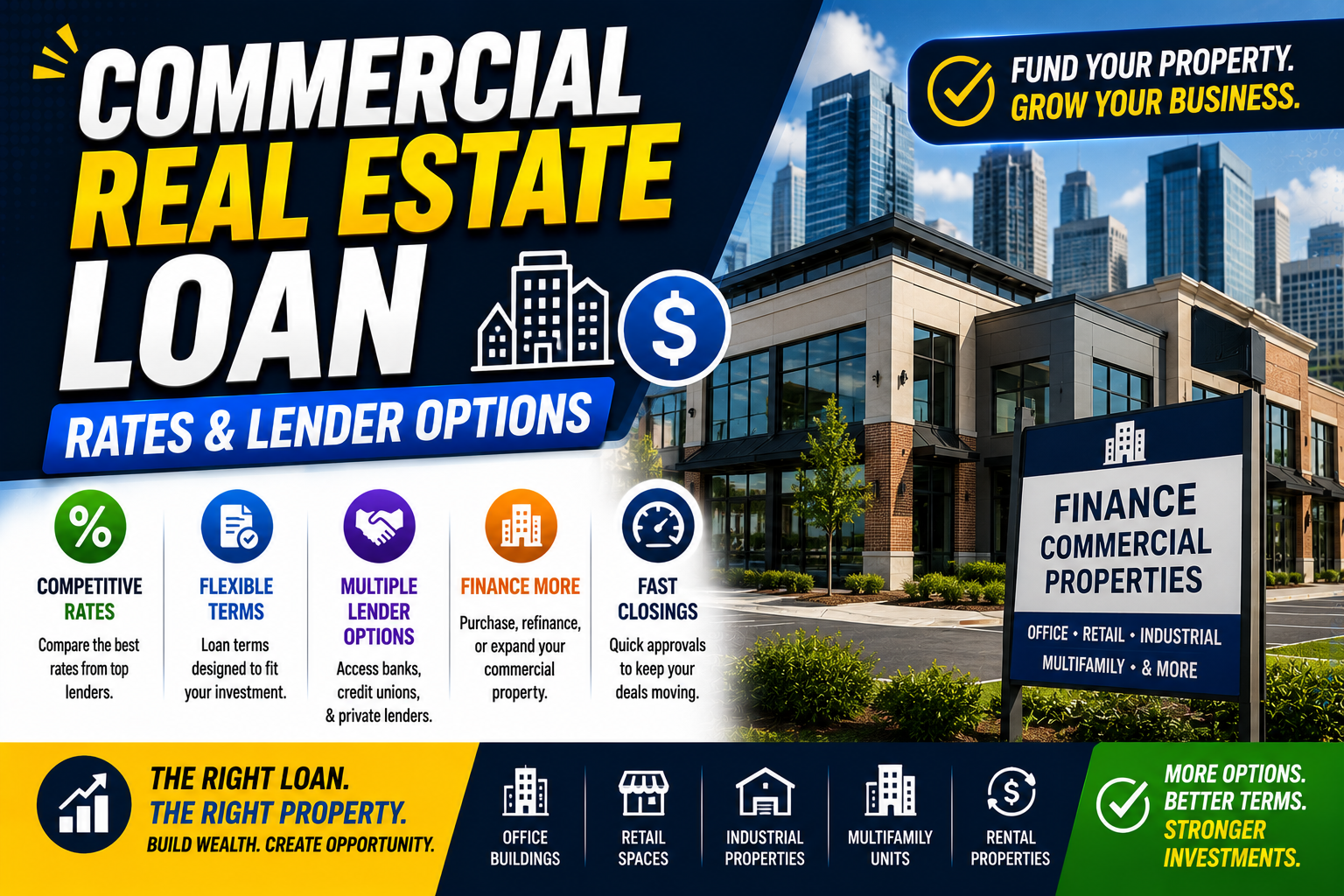
A Commercial Real Estate Loan (CRE Loan) is one of the most important financing tools available to business owners, real estate investors, developers, and commercial property operators. Whether purchasing an office building, retail center, warehouse, industrial facility, multifamily property, or mixed-use development, commercial financing can provide the capital needed to acquire and grow valuable real estate assets.
Unlike residential mortgages, commercial real estate loans involve more extensive underwriting, larger loan amounts, property cash-flow analysis, and borrower financial evaluation. Understanding how these loans work can help borrowers compare financing options, estimate costs, improve approval odds, and make informed borrowing decisions.

What Is a Commercial Real Estate Loan?
A Commercial Real Estate Loan is financing secured by business-related real estate. The property itself serves as collateral, and lenders evaluate both borrower qualifications and property performance when making lending decisions.
Commercial real estate financing may be used for:
- Purchasing office buildings
- Acquiring retail properties
- Buying industrial facilities
- Warehouse acquisitions
- Multifamily property investments
- Commercial construction projects
- Property renovations and improvements
- Refinancing existing commercial debt
- Business expansion through real estate ownership
What Financial Problems Does a Commercial Real Estate Loan Solve?
Commercial property financing helps businesses and investors address several challenges:
- High upfront property acquisition costs
- Business expansion needs
- Rising commercial lease expenses
- Investment portfolio growth objectives
- Commercial property development opportunities
- Property renovation funding requirements
- Refinancing expensive existing debt
- Long-term wealth-building strategies
For many businesses, owning commercial property can provide operational stability while potentially building equity over time.
Who Should Consider a Commercial Real Estate Loan?
Commercial real estate financing may be suitable for:
- Small business owners
- Commercial property investors
- Real estate developers
- Professional practices
- Manufacturing companies
- Retail operators
- Healthcare facilities
- Warehouse operators
- Multifamily property investors
- Franchise businesses
Real-World Borrowing Scenarios
- A medical practice purchasing its office building
- A retailer acquiring a storefront location
- An investor purchasing a multifamily property
- A logistics company buying warehouse space
- A developer financing a mixed-use project
- A business refinancing an existing commercial mortgage
Commercial Real Estate Loan Rates, Costs & Terms
| Loan Feature | Typical Range |
|---|---|
| Loan Amount | $100,000 – $50 Million+ |
| APR | 5.5% – 14% |
| Down Payment | 10% – 35% |
| Loan Term | 5 – 30 Years |
| Amortization Period | 10 – 30 Years |
| Origination Fees | 0.5% – 3% |
| Closing Costs | 2% – 6% |
| Funding Timeline | 30 – 120 Days |
Actual borrowing costs vary based on property type, borrower strength, loan structure, lender policies, and economic conditions.
Estimated Monthly Payment Examples
| Loan Amount | APR | Term | Approximate Monthly Payment |
|---|---|---|---|
| $500,000 | 7% | 20 Years | $3,878 |
| $1,000,000 | 7% | 20 Years | $7,756 |
| $2,500,000 | 6.5% | 25 Years | $16,882 |
Commercial Real Estate Loan Types Compared
| Loan Type | Best For | Term Range | Collateral |
|---|---|---|---|
| Commercial Mortgage | Property Acquisition | 5–30 Years | Property |
| SBA 504 Loan | Owner-Occupied Property | 10–25 Years | Property |
| SBA 7(a) Loan | Multi-Purpose Financing | Up to 25 Years | Varies |
| Bridge Loan | Short-Term Financing | 6–36 Months | Property |
| Construction Loan | Development Projects | 1–5 Years | Land/Project |
| Commercial Line of Credit | Flexible Capital Needs | Revolving | Varies |
Fixed-Rate vs Variable-Rate Commercial Loans
| Feature | Fixed Rate | Variable Rate |
|---|---|---|
| Payment Stability | High | Lower |
| Rate Changes | No | Yes |
| Budget Predictability | Strong | Moderate |
| Interest Rate Risk | Lower | Higher |
Best Commercial Real Estate Lenders Compared
| Lender | Best For | Strength | Potential Limitation |
|---|---|---|---|
| Bank of America | Established Businesses | Broad Commercial Lending Platform | Stricter Underwriting |
| Wells Fargo | Commercial Property Financing | Large CRE Lending Portfolio | Extensive Documentation |
| Chase | Relationship Banking | National Commercial Lending Presence | Competitive Qualification Standards |
| U.S. Bank | Owner-Occupied Properties | Diverse Financing Programs | Regional Market Differences |
| Live Oak Bank | SBA Commercial Real Estate Loans | SBA Expertise | Business Eligibility Requirements |
| Funding Circle | Business Expansion Capital | Alternative Financing Solutions | Not Primarily CRE-Focused |
| Bluevine | Working Capital Support | Fast Access to Capital | Limited Property Financing Focus |
| OnDeck | Short-Term Business Funding | Speed | Higher Cost Structure |
| National Funding | Flexible Qualification Profiles | Alternative Underwriting | May Cost More Than Bank Financing |
Lender Positioning Insights
Traditional Banks
Bank of America, Wells Fargo, Chase, and U.S. Bank often offer competitive commercial mortgage rates, larger loan amounts, and longer repayment structures. However, borrowers typically face stricter underwriting standards and longer approval timelines. Some investors may also consider a Hard Money Loan when speed and flexible qualification requirements are priorities. Reviewing a Commercial Insurance Guide can also help property owners and businesses better understand coverage options associated with commercial real estate investments.
Live Oak Bank
Frequently evaluated by borrowers pursuing SBA-backed commercial property financing, particularly owner-occupied real estate transactions.
Alternative Business Lenders
Funding Circle, Bluevine, OnDeck, and National Funding are generally more focused on business financing and working capital than long-term commercial property acquisition financing.
Consumer Lenders
SoFi, LendingClub, Upstart, and LightStream primarily specialize in personal lending products and are generally not major commercial real estate lenders.
How Commercial Real Estate Underwriting Works
Commercial lenders evaluate both the borrower and the property.
Credit Score
Strong personal and business credit histories often improve financing opportunities.
Payment History
Lenders review prior repayment behavior across business and personal obligations.
Debt-to-Income Ratio (DTI)
Personal debt levels may influence approval decisions when personal guarantees are required.
Business Revenue
Stable revenue demonstrates repayment capacity.
Cash Flow
Lenders frequently evaluate Debt Service Coverage Ratio (DSCR) to measure affordability.
Property Performance
Income-producing properties may be assessed based on occupancy, rent rolls, and net operating income.
Collateral Value
The commercial property itself typically serves as collateral.
Existing Debt Obligations
Outstanding liabilities affect overall risk assessments.
Factors That Influence Commercial Real Estate Loan Rates
- Credit score
- Business revenue
- Cash flow strength
- Property type
- Loan-to-value ratio (LTV)
- Debt service coverage ratio (DSCR)
- Property location
- Loan amount
- Loan term length
- Economic conditions
- Industry risk profile
Commercial Real Estate Loan Application Process
1. Prequalification
Review financing objectives, property details, and lender requirements.
2. Application Submission
Provide borrower, business, and property information.
3. Documentation Collection
- Business tax returns
- Personal tax returns
- Profit and loss statements
- Balance sheets
- Bank statements
- Property appraisals
- Lease agreements
- Business licenses
- Entity documentation
4. Underwriting Review
The lender evaluates borrower risk, property quality, and repayment capacity.
5. Approval Decision
Qualified borrowers receive loan terms and disclosures.
6. Closing & Funding
Funds are disbursed after legal documentation and closing requirements are completed.
How to Improve Approval Odds
- Strengthen business financials
- Improve credit scores
- Reduce outstanding debt
- Increase down payment contributions
- Maintain organized financial records
- Improve DSCR ratios
- Build liquidity reserves
- Prepare a strong business plan
How to Lower Commercial Borrowing Costs
- Compare multiple lenders
- Increase equity contributions
- Improve cash-flow metrics
- Reduce leverage levels
- Select appropriate loan terms
- Consider SBA financing when eligible
Potential Risks of Commercial Real Estate Loans
- Large debt obligations
- Property market fluctuations
- Interest rate risk
- Vacancy risk
- Cash-flow disruptions
- Balloon payment exposure
- Refinancing challenges
- Foreclosure risk if obligations cannot be met
State and Regulatory Considerations
Commercial lending regulations, disclosure requirements, licensing standards, foreclosure procedures, and borrower protections may vary by state. Certain financing products, rates, and eligibility requirements may differ depending on jurisdiction.
Frequently Asked Questions
1. What is a commercial real estate loan?
A loan used to purchase, refinance, construct, or improve business-related real estate.
2. What credit score is needed for a commercial real estate loan?
Requirements vary by lender, but stronger credit generally improves financing options.
3. How much can I borrow?
Loan amounts range from thousands to tens of millions of dollars depending on property value and qualifications.
4. What is DSCR?
Debt Service Coverage Ratio measures a property’s ability to generate sufficient income to cover debt payments.
5. What is LTV?
Loan-to-value compares the loan amount to the property’s appraised value.
6. Do commercial real estate loans require collateral?
Yes. The financed property typically serves as collateral.
7. Are rates fixed or variable?
Commercial loans may offer either fixed-rate or variable-rate structures.
8. How long does approval take?
Funding timelines commonly range from several weeks to several months.
9. What fees should borrowers expect?
Origination fees, appraisal fees, legal fees, title charges, and closing costs may apply.
10. Can SBA loans finance commercial property?
Yes. SBA 504 and SBA 7(a) programs may support eligible commercial property purchases.
11. What is a commercial mortgage?
A commercial mortgage is a loan secured by business-related real estate.
12. Can investors qualify?
Many lenders finance both owner-occupied and investment commercial properties.
13. Can I refinance a commercial real estate loan?
Yes. Refinancing may help adjust terms, rates, or loan structures.
14. What documentation is required?
Financial statements, tax returns, property records, and business information are commonly requested.
15. Should I compare lenders before applying?
Yes. Loan structures, rates, fees, and underwriting standards vary significantly.
Related Topics
- SBA 504 Loan Guide
- Commercial Mortgage Rates
- Bridge Loan Financing
- Commercial Construction Loans
- DSCR Loan Guide
- Investment Property Financing
- Business Line of Credit
- Commercial Property Refinancing