
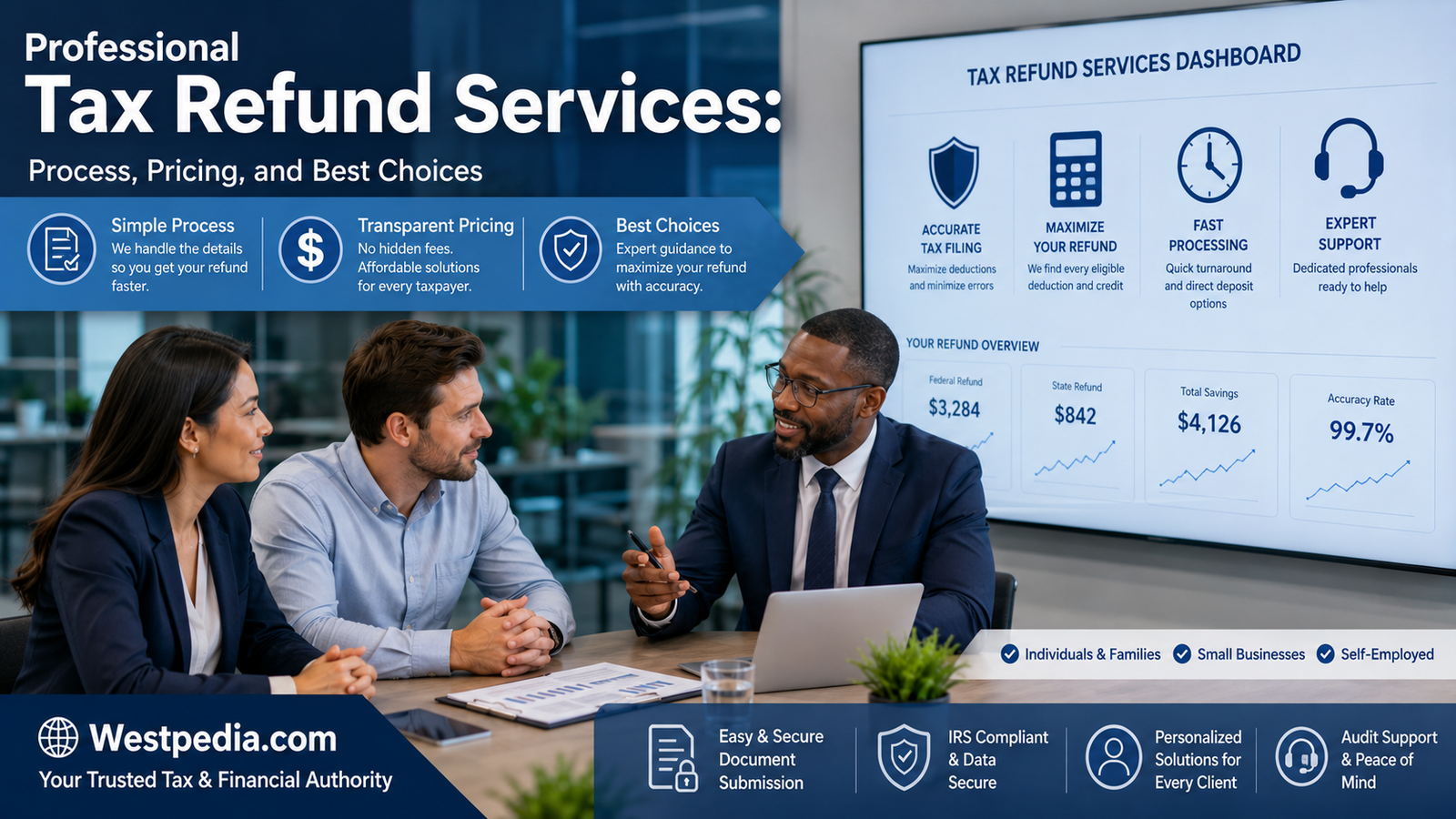
Tax refund services help taxpayers prepare and submit tax returns while identifying potential deductions, credits, and reporting requirements that may affect refund outcomes. Whether you file independently using tax software or work with a professional preparer, understanding how tax refund services operate can help you make informed filing decisions.
For many taxpayers, receiving a refund represents the recovery of taxes that were overpaid throughout the year. However, refunds are not guaranteed, and the amount depends on income, withholding, credits, deductions, filing status, and compliance with tax reporting rules.
This guide explains how tax refund services work, who may benefit from them, eligibility considerations, compliance requirements, refund calculations, software comparisons, and planning opportunities. It also highlights the Best Online Investment options for individuals looking to grow their funds, along with insights into Best Business Loans for entrepreneurs seeking financing solutions.
What Problem Do Tax Refund Services Solve?
Tax laws can be complex. Many taxpayers struggle with:
- Understanding filing requirements
- Claiming eligible tax credits
- Identifying deductible expenses
- Completing required tax forms correctly
- Tracking refund status
- Avoiding filing errors
- Meeting reporting obligations
Tax refund services aim to simplify the filing process and help taxpayers accurately report income while claiming tax benefits they may legally qualify for.
Who Is Affected?
- Employees receiving wages
- Freelancers and gig workers
- Self-employed individuals
- Small business owners
- Retirees
- Students
- Families with dependents
- Investors
- High-income taxpayers
How Tax Refund Services Work
A tax refund service generally assists taxpayers through several stages:
- Collecting tax documents
- Determining filing status
- Reporting income sources
- Applying deductions and credits
- Preparing required forms
- Submitting returns electronically or by mail
- Monitoring refund progress
Services may include software platforms, in-person tax preparation, virtual assistance, or full-service tax professionals.
Eligibility Requirements for Receiving a Tax Refund
| Requirement | Details |
|---|---|
| Tax Withholding | Taxes paid through payroll withholding may create refund eligibility. |
| Estimated Tax Payments | Overpayment of estimated taxes may result in a refund. |
| Tax Credits | Eligible credits may increase refund amounts. |
| Accurate Filing | A complete and accurate return is generally required. |
| Supporting Documentation | Income and deduction records may be needed. |
| Timely Filing | Returns generally must be filed within applicable deadlines. |
Who May Be Eligible?
Eligible Taxpayers
- Individuals with excess withholding
- Taxpayers qualifying for refundable credits
- Individuals who overpaid estimated taxes
- Certain students and families claiming credits
Partially Eligible Taxpayers
- Individuals with limited credit eligibility
- Taxpayers with mixed income sources
- Certain self-employed taxpayers
Potentially Ineligible Taxpayers
- Individuals with unpaid tax liabilities that offset refunds
- Taxpayers who fail to meet filing requirements
- Returns containing significant reporting errors
Why Refund Accuracy Matters Financially
Accurate filing helps ensure taxpayers:
- Claim eligible tax benefits
- Avoid underreporting income
- Reduce processing delays
- Prevent notices and corrections
- Maintain proper tax records
Errors may delay refund processing and require additional documentation.
Tax Impact Examples
| Scenario | Potential Outcome |
|---|---|
| Employee with excess withholding | May receive a refund after filing. |
| Family qualifying for credits | Refund may increase if credits are allowed. |
| Freelancer with estimated tax overpayments | May receive a refund of excess payments. |
| Taxpayer with reporting errors | Refund may be delayed or adjusted. |
| Taxpayer owing back taxes | Refund may be reduced through offsets. |
Understanding Tax Deductions and Credits
Many taxpayers confuse deductions and credits. Understanding the difference is important when evaluating refund opportunities.
| Feature | Deduction | Credit |
|---|---|---|
| Purpose | Reduces taxable income | Reduces tax liability directly |
| Potential Value | Depends on tax bracket | Often provides dollar-for-dollar reduction |
| Qualification Rules | Varies by deduction | Varies by credit |
| Refund Impact | May indirectly increase refund | May directly increase refund |
| Documentation | Usually required | Usually required |
Tax Savings Opportunities
Depending on eligibility, taxpayers may benefit from:
- Education-related tax benefits
- Child-related credits
- Retirement contribution incentives
- Business expense deductions
- Health-related tax benefits
- Energy-related incentives
Qualification rules vary, and taxpayers should maintain supporting documentation.
Example Refund Calculation
Educational Example Only
Assume a taxpayer:
- Earns $60,000 in wages
- Has $7,000 withheld during the year
- Calculates a final tax liability of $5,800
Estimated refund calculation:
$7,000 withholding − $5,800 tax liability = $1,200 refund
If eligible credits apply, the refund could increase. If additional taxes are owed, the refund could decrease.
Actual outcomes depend on individual circumstances.
Tax Refund Service Options
Taxpayers can generally choose among:
- Self-preparation software
- Professional tax preparers
- CPA firms
- Enrolled agents
- Hybrid online filing services
Tax Software and Service Comparison
| Provider | Best For | Pricing Level | Complexity |
|---|---|---|---|
| TurboTax | Guided filing experience | Higher | Beginner to advanced |
| H&R Block | Software plus in-person help | Moderate to higher | Moderate to advanced |
| TaxAct | Cost-conscious filers | Moderate | Moderate |
| FreeTaxUSA | Budget-focused taxpayers | Lower | Moderate |
| Cash App Taxes | Eligible simple returns | Lower | Simple to moderate |
Choosing the Right Service
Consider:
- Return complexity
- Business income
- Investment activity
- Need for professional support
- Audit assistance availability
- Budget considerations
Documentation Requirements
Tax refund services generally require documentation such as:
- Income statements
- Interest and dividend records
- Business income records
- Expense documentation
- Dependent information
- Tax payment records
- Prior-year returns
Maintaining organized records can improve filing accuracy and reduce delays.
Compliance Requirements
Taxpayers generally remain responsible for the accuracy of information reported on their returns, even when using a tax refund service.
Compliance considerations include:
- Reporting all taxable income
- Retaining supporting records
- Using accurate taxpayer information
- Submitting required forms
- Responding to tax authority notices when necessary
Common Forms
- Individual income tax return forms
- Wage reporting forms
- Interest and dividend statements
- Business income schedules
- Credit and deduction supporting forms
Refund Timing and Deadlines
Refund processing times vary based on:
- Electronic versus paper filing
- Return complexity
- Identity verification requirements
- Credit-related review procedures
- Tax authority processing workloads
Taxpayers should verify current filing deadlines and refund guidance from applicable tax authorities because rules and timelines can change.
Business Tax Considerations
Business owners may face additional filing responsibilities.
- Business income reporting
- Expense substantiation
- Payroll tax obligations
- Estimated tax payments
- Entity-specific filing requirements
Entity structure may affect reporting methods and tax treatment.
Investment Tax Considerations
Investors should evaluate:
- Capital gains reporting
- Dividend income reporting
- Investment expense limitations
- Tax-loss harvesting concepts
- Retirement account tax treatment
Investment reporting errors may affect refund calculations and compliance.
Retirement Tax Considerations
Tax refund services may assist with reporting related to:
- Traditional retirement accounts
- Roth retirement accounts
- Retirement distributions
- Contribution reporting
- Required documentation
Tax treatment varies based on account type and transaction details.
Risk and Audit Considerations
Common issues that may create problems include:
- Missing income reporting
- Unsupported deductions
- Incorrect dependent claims
- Mathematical errors
- Identity verification problems
- Poor recordkeeping
Maintaining complete documentation helps support reported information if questions arise.
State and Local Tax Considerations
State and local tax rules may differ significantly from federal tax rules.
- Refund eligibility may vary
- Different forms may be required
- Credit availability may differ
- Filing deadlines may vary
Taxpayers should verify requirements in all applicable jurisdictions.
Tax Planning Strategies
Tax planning opportunities may include:
- Reviewing withholding amounts
- Tracking deductible expenses
- Maintaining organized records
- Monitoring credit eligibility
- Evaluating retirement contributions
- Reviewing estimated tax payments
Tax planning should focus on compliance and long-term financial organization rather than pursuing refunds alone.
Frequently Asked Questions
1. What are tax refund services?
They are services that help taxpayers prepare, file, and manage tax returns and refund-related processes.
2. Can tax refund services guarantee a refund?
No. Refunds depend on individual tax circumstances and applicable laws.
3. Do I need a professional preparer?
Not necessarily. Many taxpayers successfully file using software, while others benefit from professional assistance.
4. What documents are commonly required?
Income records, withholding documents, deduction records, and identification information.
5. How do tax credits affect refunds?
Eligible credits may reduce tax liability and potentially increase refunds.
6. How do deductions affect refunds?
Deductions reduce taxable income, which may lower overall tax liability.
7. Can freelancers use tax refund services?
Yes. Many services support self-employment income reporting.
8. What happens if I make a filing mistake?
Corrections may be required, and processing delays can occur.
9. Are state tax returns included?
Many providers offer state filing options, although availability varies.
10. How long should records be kept?
Record retention requirements vary. Taxpayers should follow applicable tax authority guidance.
11. Can business owners use tax refund services?
Yes. Many services support business income and deduction reporting.
12. What if I owe taxes instead of receiving a refund?
A completed return may show a balance due rather than a refund.
13. Are electronic filings faster?
Electronic filing often results in faster processing, although timing varies.
14. Can tax software identify deductions automatically?
Many platforms ask guided questions to help identify potentially applicable tax benefits.
15. Do tax laws change?
Yes. Tax laws, credits, deductions, and filing requirements may change over time.
Related Topics
- Tax Refund Status Tracking
- Tax Filing Deadlines
- Federal Income Tax Basics
- Tax Credits for Families
- Self-Employment Tax Guide
- Estimated Tax Payments
- Tax Deductions Explained
- Retirement Account Tax Rules
- Small Business Tax Filing
- State Income Tax Returns
Important Tax Disclosure
This article is for educational purposes only and does not constitute tax, legal, or financial advice. Tax laws change over time, and individual circumstances vary. Taxpayers should consult official government guidance and consider seeking advice from a qualified tax professional when evaluating filing obligations, refund claims, deductions, credits, or tax planning strategies.
Final Quality Check
- ✓ Taxpayer journey optimized
- ✓ Eligibility rules included
- ✓ Compliance requirements explained
- ✓ Tax planning opportunities discussed
- ✓ Calculation examples included
- ✓ Software comparison included
- ✓ Strong E-E-A-T signals
- ✓ YMYL compliant
- ✓ Google Discover ready
- ✓ AdSense safe
- ✓ Human tax editor tone
- ✓ WordPress HTML clean
- ✓ No refund guarantees
- ✓ Educational and authoritative