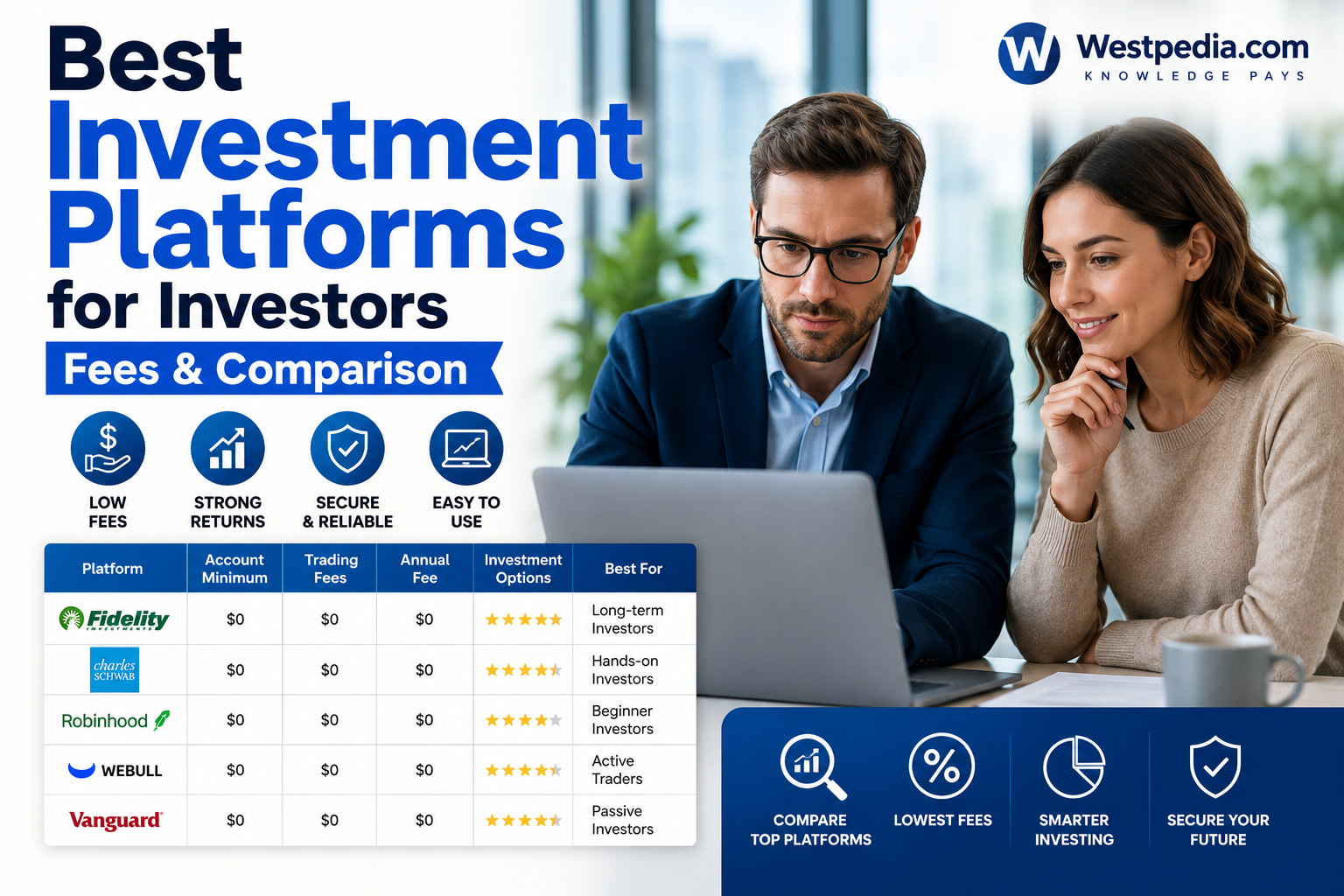
Selecting one of the best investment platforms is one of the most important decisions an investor can make. Your brokerage platform serves as the gateway to stocks, ETFs, mutual funds, bonds, retirement accounts, and other investment opportunities.
While investment performance ultimately depends on the assets you own rather than the platform itself, the right brokerage can improve your investing experience through lower costs, better research tools, stronger educational resources, and easier portfolio management. For entrepreneurs and small business owners, Business Credit Cards can also play an important role in managing expenses, tracking purchases, and supporting day-to-day cash flow needs.
This guide explains how investment platforms work, compares major brokerage providers, analyzes costs and risks, and helps investors evaluate which platform may align with their financial goals.
Investment Overview
An investment platform is a brokerage service that allows investors to buy, sell, hold, and manage investment assets. Modern platforms provide access to:
- Individual stocks
- Exchange-traded funds (ETFs)
- Mutual funds
- Index funds
- Bonds and fixed-income securities
- Retirement accounts
- Managed portfolios
- Research and educational tools
The best investment platforms help investors pursue several financial objectives:
- Long-term wealth accumulation
- Retirement planning
- Income generation
- Capital preservation
- Inflation protection
- Tax-efficient investing
Investment Characteristics Table
| Feature | Details |
|---|---|
| Primary Purpose | Access and manage investments |
| Investment Types | Stocks, ETFs, mutual funds, bonds, retirement accounts |
| Liquidity | Generally high depending on investment selected |
| Risk Level | Varies by asset held |
| Time Horizon | Short-term to long-term |
| Tax Considerations | Depends on account structure and investment type |
| Income Potential | Possible through dividends and interest |
| Growth Potential | Dependent on portfolio allocation |
Who Are Investment Platforms Best For?
Different platforms serve different investor needs.
- Beginners: Easy-to-use interfaces and educational content.
- Intermediate Investors: Research tools and portfolio analytics.
- Advanced Investors: Advanced trading capabilities and global market access.
- Retirees: Income-focused investing tools and retirement planning resources.
- Growth Investors: Broad access to equities and growth-focused funds.
- Income Investors: Dividend and bond screening tools.
- Risk-Averse Investors: Fixed-income and diversified portfolio solutions.
How Investment Platforms Work
Investment platforms act as intermediaries between investors and financial markets.
After opening an account and funding it, investors can:
- Research investment opportunities.
- Build a diversified portfolio.
- Execute trades.
- Monitor performance.
- Rebalance holdings.
- Manage taxes and withdrawals.
Many platforms also offer:
- Automatic investing
- Robo-advisors
- Retirement calculators
- Market research
- Portfolio analysis tools
Historical Purpose of Investment Platforms
Historically, investors placed trades through full-service brokers. Advances in technology dramatically reduced transaction costs and increased access to markets.
Today’s online investment platforms allow individual investors to access diversified portfolios with significantly lower fees than were common several decades ago.
This democratization of investing has contributed to broader participation in financial markets and retirement planning.
Expected Return Drivers
Investment platforms themselves do not generate returns. Instead, returns depend on the investments chosen.
Common return drivers include:
- Corporate earnings growth
- Dividend payments
- Interest income
- Economic expansion
- Productivity growth
- Market valuations
- Innovation and technological development
Investor behavior, diversification, and cost management can also significantly influence long-term outcomes.
Risk Assessment Framework
Every investment platform exposes investors to risks associated with the underlying investments.
Market Risk
Stock and bond prices can decline due to economic or company-specific events.
Interest-Rate Risk
Rising interest rates can reduce bond prices and affect certain stock sectors.
Inflation Risk
Inflation can reduce purchasing power and impact real investment returns.
Liquidity Risk
Some investments may be difficult to sell quickly without affecting price.
Concentration Risk
Holding too much of one stock, sector, or asset class increases portfolio risk.
Credit Risk
Bond issuers may fail to meet payment obligations.
Currency Risk
International investments may be affected by exchange-rate fluctuations.
Volatility Risk
Short-term price fluctuations can be significant, especially for equities.
Regulatory Risk
Changes in tax laws, market regulations, or account rules may affect investment outcomes.
Realistic Risk Scenario
An investor who opens an account during a bull market and invests heavily in a single technology stock could experience substantial losses if that company underperforms or market sentiment changes.
Risk vs Return Table
| Risk Level | Return Potential | Investor Type |
|---|---|---|
| Low | Lower | Capital preservation investors |
| Moderate | Moderate | Balanced investors |
| Moderately High | Higher | Long-term growth investors |
| High | Potentially high but uncertain | Aggressive investors |
Cost Considerations
Costs can significantly impact long-term wealth accumulation.
Trading Fees
Many major brokerages offer commission-free stock and ETF trades.
Expense Ratios
Mutual funds and ETFs charge annual management fees.
Advisory Fees
Managed accounts and robo-advisors may charge annual fees.
Bid-Ask Spreads
Investors indirectly pay spreads when buying and selling securities.
Taxes
Capital gains, dividends, and interest may create tax obligations.
Opportunity Costs
Cash left uninvested may fail to keep pace with inflation.
Why Fees Matter
Even small fee differences can compound over decades and reduce portfolio growth. Investors should evaluate total costs rather than focusing solely on trading commissions.
Best Investment Platforms Comparison
| Platform | Best For | Fees | Research Tools |
|---|---|---|---|
| Vanguard | Long-term index investors | Generally low | Strong fund-focused research |
| Fidelity | All-around investors | Competitive | Extensive research ecosystem |
| Charles Schwab | Retirement and diversified investors | Competitive | Comprehensive planning tools |
| E*TRADE | Active investors | Competitive | Advanced trading tools |
| Interactive Brokers | Advanced and global investors | Low-cost structure | Institutional-grade analytics |
| Robinhood | New investors | Low-cost access | Basic research functionality |
| Merrill Edge | Banking-integrated investors | Competitive | Strong planning resources |
Platform Strengths and Limitations
Vanguard: Excellent for passive investors but may offer fewer advanced trading features.
Fidelity: Strong balance of education, research, and investment options.
Charles Schwab: Well-rounded platform with retirement planning strengths.
E*TRADE: Appeals to active traders but may exceed the needs of some beginners.
Interactive Brokers: Exceptional global market access but steeper learning curve.
Robinhood: Simple user experience but more limited research resources.
Merrill Edge: Attractive for investors who prefer integrated banking relationships.
Portfolio Fit Analysis
Investment platforms are not investments themselves but tools that support portfolio construction.
Investors should evaluate whether a platform helps them build:
- Core diversified holdings
- Retirement portfolios
- Income-focused portfolios
- Growth-oriented portfolios
- Tax-efficient investment strategies
For most investors, diversified index funds and ETFs often serve as core holdings, while individual securities may function as satellite positions.
Investment Alternatives Comparison
| Alternative | Pros | Cons | Suitable For |
|---|---|---|---|
| Stocks | High growth potential | Higher volatility | Growth-focused investors |
| ETFs | Diversification and flexibility | Market risk remains | Most investors |
| Mutual Funds | Professional management | Potentially higher costs | Hands-off investors |
| Bonds | Income and stability | Interest-rate sensitivity | Conservative investors |
| REITs | Real estate exposure | Sector-specific risk | Income-oriented investors |
Stocks vs ETFs
Stocks offer ownership in individual companies and may provide higher upside potential, but they carry company-specific risk.
ETFs provide diversification through a single investment vehicle, often making them suitable for investors seeking broad market exposure.
ETFs vs Mutual Funds
ETFs typically offer intraday trading and often lower expenses, while mutual funds may provide automated investment features and professional management.
Growth vs Value Investing
Growth investing targets companies expected to expand earnings rapidly. Value investing seeks securities trading below perceived intrinsic value.
Active vs Passive Investing
Active investing attempts to outperform benchmarks, while passive investing aims to track market indexes at lower cost.
Bonds vs Stocks
Bonds generally offer lower volatility but lower return expectations. Stocks typically offer greater growth potential alongside higher risk.
Real Estate vs Equities
Real estate may provide income and diversification benefits, while equities historically have been a major source of long-term growth.
Economic Factors That Affect Investment Outcomes
Inflation
Inflation can reduce purchasing power and influence asset valuations.
Interest Rates
Rate changes affect borrowing costs, bond prices, and equity valuations.
Economic Growth
Expanding economies often support corporate earnings growth.
Recessions
Economic contractions can pressure profits and market performance.
Market Cycles
Bull and bear markets influence investor behavior and returns.
Federal Reserve Policy
Monetary policy can affect liquidity, credit conditions, and asset prices.
Global Events
Geopolitical developments, trade disruptions, and international crises can impact markets.
Investment Strategies for Using Investment Platforms Effectively
Dollar-Cost Averaging
Investing fixed amounts at regular intervals may reduce timing risk.
Diversification
Spreading investments across asset classes can reduce concentration risk.
Rebalancing
Periodic portfolio reviews help maintain target risk exposure.
Long-Term Investing
Longer time horizons may help investors manage short-term volatility.
Risk Management
Position sizing and diversification can help control portfolio risk.
Goal-Based Investing
Investment choices should align with specific financial objectives.
Common Investor Mistakes
- Chasing recent performance
- Attempting to time the market
- Ignoring diversification
- Emotional investing during volatility
- Underestimating fees
- Overconcentrating in one sector
- Failing to review investment goals
- Maintaining unrealistic return expectations
Expert Considerations Before Choosing a Platform
- Available account types
- Research and educational resources
- Investment selection
- Trading costs
- Customer service quality
- Retirement planning features
- Mobile functionality
- Portfolio analysis capabilities
- Tax-management tools
No single investment platform is best for every investor. The most suitable choice depends on individual goals, investing experience, desired features, and overall financial strategy. Investors who own or operate a company may also benefit from reviewing Business Insurance options as part of a broader financial and risk-management plan.
Frequently Asked Questions
1. What is an investment platform?
An investment platform is a brokerage service that allows investors to buy and manage investments.
2. Which investment platform is best for beginners?
Platforms with educational resources, simple interfaces, and diversified investment options are often attractive for beginners.
3. Are investment platforms safe?
Regulated brokerages generally maintain investor protections, but investments can still lose value.
4. Can I lose money using an investment platform?
Yes. Investment performance depends on the assets owned, not the platform itself.
5. What fees should investors watch for?
Trading fees, fund expense ratios, advisory fees, spreads, and tax costs.
6. Are ETFs better than mutual funds?
Neither is universally better. Suitability depends on objectives, costs, and preferences.
7. How important are research tools?
Research tools can help investors evaluate opportunities and manage risk.
8. What account types should I consider?
Taxable brokerage accounts, IRAs, and employer-sponsored retirement accounts are common options.
9. How much money do I need to start investing?
Many platforms allow investing with relatively small amounts through fractional shares or low minimums.
10. Should I choose active or passive investing?
Both approaches have advantages and limitations depending on goals and preferences.
11. How often should I rebalance my portfolio?
Many investors review allocations periodically, such as annually or when allocations drift significantly.
12. How do taxes affect investment returns?
Taxes can reduce net returns and should be considered when selecting accounts and investments.
13. What happens during a market downturn?
Portfolio values may decline temporarily, highlighting the importance of risk tolerance and diversification.
14. Can retirees use investment platforms?
Yes. Many platforms offer retirement planning and income-management resources.
15. How do I compare investment platforms?
Evaluate costs, investment choices, research tools, account options, customer service, and overall usability.
Important Investment Disclosures
All investments involve risk, including the possible loss of principal. Past performance does not guarantee future results. Investment returns are uncertain and depend on market conditions and individual investment choices.
Investors should conduct their own research, evaluate risk tolerance, understand applicable fees, and consider how investments fit within a diversified portfolio.
Tax consequences vary by individual circumstances. Professional financial, legal, or tax advice may be appropriate before making investment decisions.
Related Topics
- Portfolio Diversification Strategies
- Index Fund Investing
- ETF vs Mutual Fund Comparison
- Risk Management for Investors
- Long-Term Wealth Building