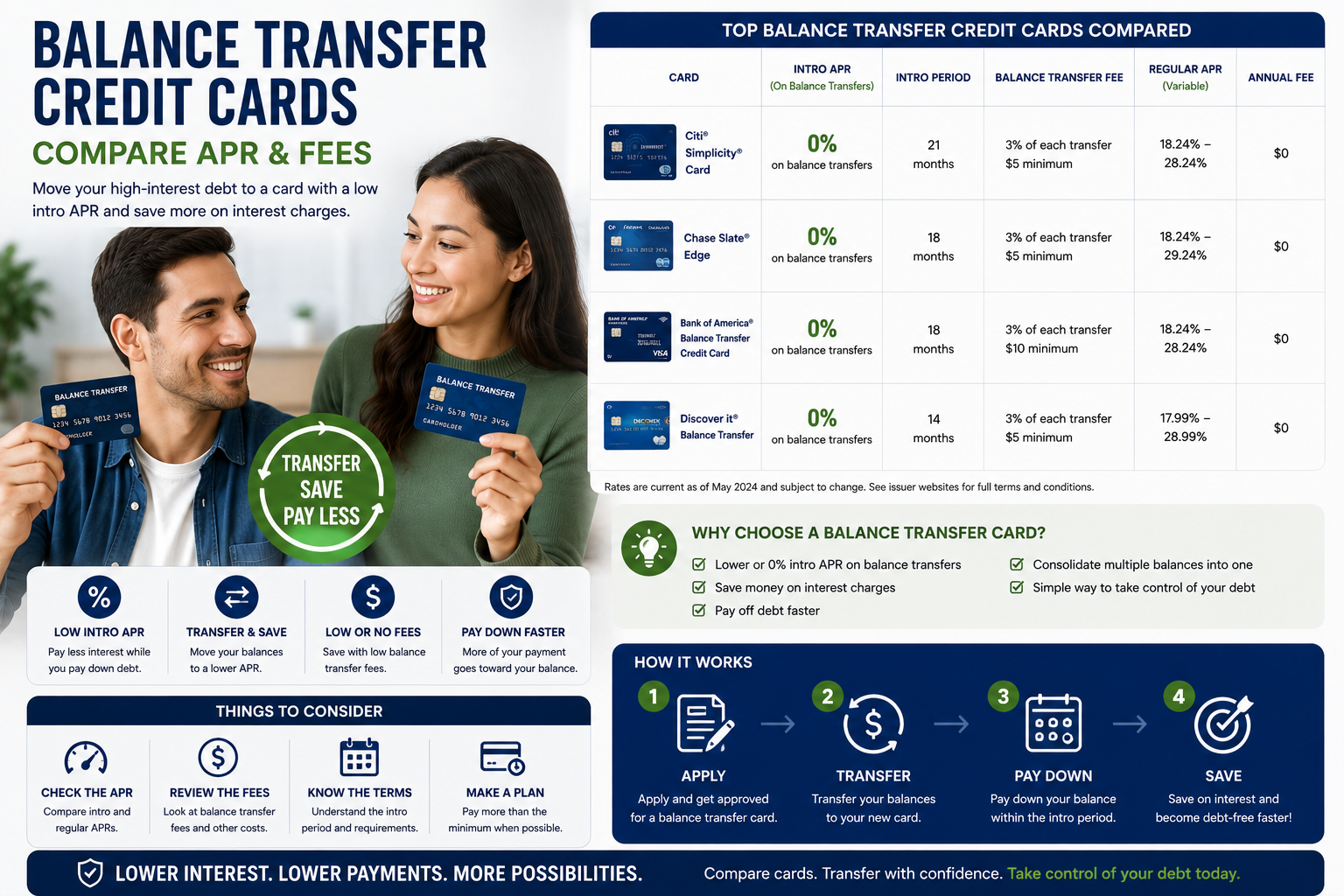
Balance transfer credit cards can provide a strategic way to reduce interest costs by moving debt from higher-rate credit cards to a new account with a lower introductory APR. For consumers carrying significant balances, selecting the right balance transfer card could potentially save substantial money in interest charges.
However, balance transfers are not appropriate for every borrower. Understanding fees, qualification requirements, repayment strategies, and promotional terms is essential before applying.
Balance Transfer Credit Cards Complete Guide
A balance transfer credit card enables cardholders to transfer existing revolving debt from one credit account to another. Many issuers offer promotional introductory APR periods—often including 0% APR—for a limited time.
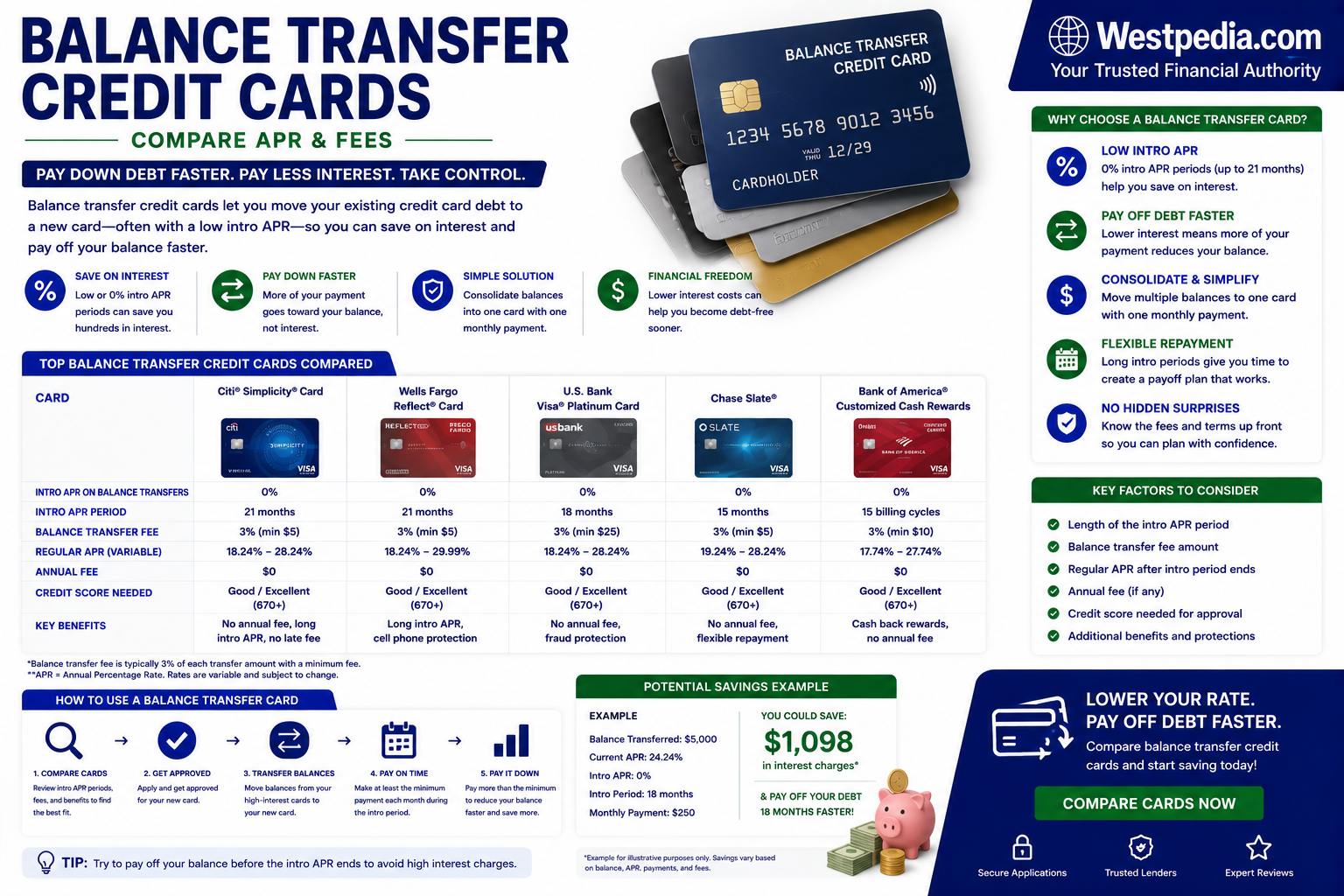
These cards are primarily designed for consumers who want to:
- Reduce borrowing costs.
- Consolidate multiple credit card balances.
- Simplify monthly payments.
- Pay off debt faster.
- Avoid accumulating additional interest during promotional periods.
Who Should Consider Balance Transfer Credit Cards?
Balance transfer cards may be suitable for:
- Consumers carrying high-interest credit card balances.
- Individuals with a structured debt repayment plan.
- Borrowers seeking short-term financing flexibility.
- Consumers consolidating multiple card balances.
- Cardholders with good or excellent credit profiles.
Individuals who routinely add new debt while repaying transferred balances may want to explore alternative debt management options.
How Balance Transfer Credit Cards Work
After approval, the new issuer pays off eligible balances from existing accounts and transfers the amount to the new card.
Cardholders then repay the transferred balance under the terms of the new account.
Most balance transfer offers include:
- Introductory 0% APR periods.
- Reduced promotional APR offers.
- Balance transfer fees.
- Variable APRs after promotional periods expire.
Balance Transfer Card Features Comparison Table
| Feature | Details |
|---|---|
| Introductory APR | Often 0% for a limited promotional period |
| Transfer Fee | Typically 3% to 5% of transferred amount |
| Ongoing APR | Variable APR after promotion ends |
| Annual Fee | Usually $0 but varies by issuer |
| Credit Requirements | Generally Good to Excellent credit |
| Debt Consolidation | Combines multiple balances into one account |
| Fraud Protection | Protection against unauthorized transactions |
| Digital Account Tools | Payment tracking and budgeting tools |
What Financial Problem Do Balance Transfer Cards Solve?
These cards primarily address:
- High credit card interest expenses.
- Managing multiple monthly payments.
- Debt repayment challenges.
- Short-term financing needs.
- Cash flow constraints.
For disciplined borrowers, promotional financing periods may accelerate debt reduction.
Understanding Introductory APR Offers
Many balance transfer cards feature introductory APR periods that may range from several months to more than a year.
Consumers should understand:
- The exact promotional period length.
- Whether purchases also qualify for intro APR.
- The ongoing APR after promotion expiration.
- Deadlines for completing transfers.
- Applicable transfer fees.
Estimated Cost Comparison Example
| Transferred Balance | Transfer Fee (3%) | Transfer Fee (5%) |
|---|---|---|
| $3,000 | $90 | $150 |
| $5,000 | $150 | $250 |
| $10,000 | $300 | $500 |
Consumers should compare fee costs against potential interest savings before proceeding.
Fees and APR Explained
| Fee Type | Typical Range |
|---|---|
| Annual Fee | $0–$150+ |
| Balance Transfer Fee | 3%–5% |
| Foreign Transaction Fee | 0%–3% |
| Cash Advance Fee | 3%–5% |
| Late Payment Fee | Issuer dependent |
Annual Fees
Many balance transfer cards do not charge annual fees, though premium products may.
Balance Transfer Fees
Most issuers charge a fee based on a percentage of the transferred balance.
Penalty APR Considerations
Late payments may trigger higher APRs or result in loss of promotional terms depending on issuer policies.
Rewards and Benefits Analysis
Balance transfer cards frequently prioritize financing features over premium rewards. Some products still offer modest rewards programs.
| Reward Category | Typical Earnings Rate |
|---|---|
| General Purchases | 1%–2% cash back |
| Dining | 1%–3% cash back |
| Travel | 1x–2x points |
| Groceries | 1%–3% cash back |
| Gas Purchases | 1%–3% cash back |
Borrowers focused on debt repayment often benefit more from maximizing interest savings rather than rewards earnings.
Credit Score Requirements
| Credit Profile | Typical FICO Range | Approval Outlook |
|---|---|---|
| Poor | 300–579 | Limited balance transfer options |
| Fair | 580–669 | Some entry-level offers available |
| Good | 670–739 | Competitive offers possible |
| Very Good | 740–799 | Strong approval potential |
| Excellent | 800–850 | Access to leading promotional offers |
Issuer Comparison Table
| Issuer | Best For | Typical Credit Needed |
|---|---|---|
| Chase | Flexible financing features | Good to Excellent |
| American Express | Premium cardholders | Good to Excellent |
| Capital One | Straightforward card management | Fair to Excellent |
| Citi | Balance transfer promotions | Good to Excellent |
| Discover | Long intro APR periods | Fair to Good |
| Bank of America | Relationship banking benefits | Good to Excellent |
| Wells Fargo | Intro APR financing offers | Good to Excellent |
Issuer Insights
Chase
Strengths: Strong digital experience and flexible products.
Weaknesses: Approval standards can be competitive.
Citi
Strengths: Often recognized for balance transfer offerings.
Weaknesses: Product features vary significantly.
Discover
Strengths: Consumer-friendly features and promotional financing.
Weaknesses: Smaller card portfolio.
Application and Underwriting Factors
- Credit score and history.
- Payment history.
- Debt-to-income ratio.
- Current credit utilization.
- Recent credit inquiries.
- Income stability.
- Length of credit history.
- Existing account relationships.
Approval Process Explained
1. Application Submission
Applicants submit personal and financial information.
2. Credit Review
Issuers review credit reports and repayment history.
3. Underwriting Assessment
Creditworthiness and repayment capacity are evaluated.
4. Approval or Denial
The issuer determines eligibility and credit limits.
5. Card Issuance Timeline
Approved applicants generally receive cards within several business days.
6. Activation Process
Cardholders activate the card and initiate eligible transfers.
How to Improve Approval Odds
- Maintain on-time payment history.
- Reduce existing credit utilization.
- Review credit reports for inaccuracies.
- Avoid multiple applications within short periods.
- Apply for products aligned with your credit profile.
How to Maximize a Balance Transfer Offer
- Create a payoff plan before transferring debt.
- Pay more than the minimum payment.
- Avoid making new purchases on the transferred balance card.
- Track the promotional APR expiration date.
- Pay off transferred balances before the intro period ends when possible.
Common Credit Card Mistakes
- Ignoring transfer fees.
- Missing promotional deadlines.
- Accumulating new debt after transferring balances.
- Making late payments.
- Failing to understand post-promotion APRs.
Benefits vs Risks
Benefits
- Potentially lower interest costs.
- Simplified debt management.
- Accelerated debt repayment.
- Temporary financing flexibility.
- Potential credit utilization improvements.
Risks
- Balance transfer fees.
- High ongoing APR after promotional periods.
- Overspending risks.
- Missed payments may increase costs.
- Debt may persist without disciplined repayment.
Alternatives to Consider
- Low interest credit cards.
- Personal loans.
- Debt consolidation loans.
- Credit counseling programs.
- Home equity financing products.
Expert Considerations
Balance transfer credit cards may provide substantial savings when used responsibly and paired with a disciplined repayment strategy. Consumers should compare promotional APR periods, transfer fees, ongoing APRs, and repayment timelines rather than focusing exclusively on introductory offers.
Approval is not guaranteed. Terms, fees, promotional periods, and APRs vary by issuer and applicant creditworthiness. Always review official issuer disclosures before applying.
Frequently Asked Questions
1. What is a balance transfer credit card?
A credit card designed to move existing debt from one account to another, often with a lower introductory APR.
2. How does a balance transfer work?
The new issuer pays eligible balances and transfers the amount to the new card.
3. Are balance transfers free?
Most issuers charge transfer fees, typically between 3% and 5%.
4. What credit score is needed?
Many competitive offers require good or excellent credit.
5. Does a balance transfer hurt credit scores?
It may temporarily affect credit scores due to new inquiries and account openings.
6. Can I transfer balances between cards from the same issuer?
Many issuers restrict transfers between their own accounts.
7. What happens after the introductory APR expires?
The standard variable APR generally applies to remaining balances.
8. How long does approval take?
Some applications receive instant decisions, while others require manual review.
9. Can I continue using my old cards?
Yes, but responsible spending habits remain important.
10. Are balance transfers considered debt consolidation?
Yes, they can consolidate multiple revolving balances into one account.
11. Is approval guaranteed?
No. Approval depends on multiple underwriting factors.
12. Can I transfer personal loan debt?
Eligibility varies by issuer and specific offer terms.