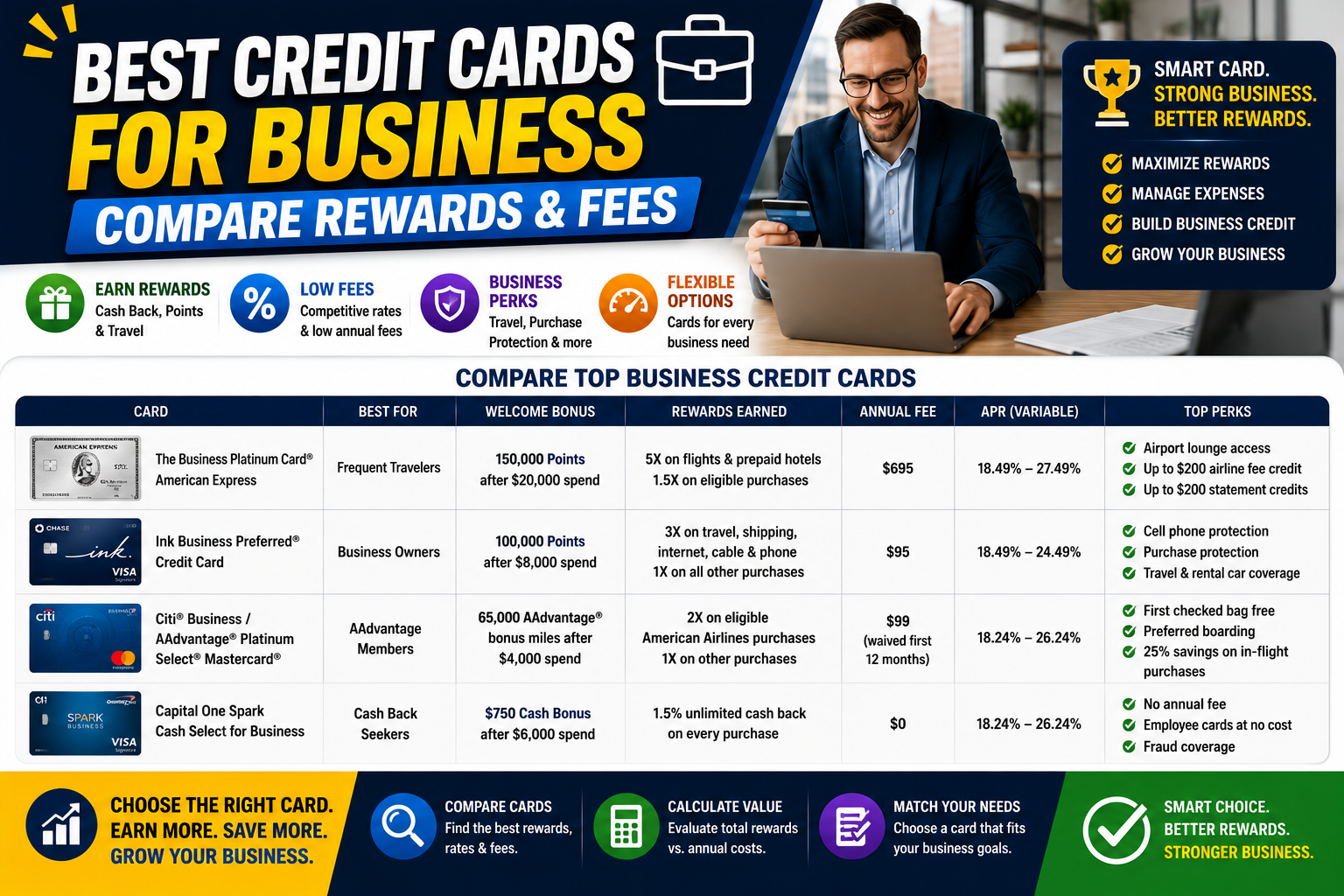
Business credit cards for business can be powerful financial tools for entrepreneurs, freelancers, startups, and established companies. The right card can help separate business expenses from personal spending, simplify accounting, improve cash flow management, and generate valuable rewards on everyday purchases.
However, there is no single business credit card that works best for every company. The ideal card depends on spending patterns, travel needs, cash flow requirements, employee management needs, and overall business goals.
This guide compares the best credit cards for business, explains how they work, analyzes costs and rewards, and helps business owners identify which type of card may provide the greatest value.
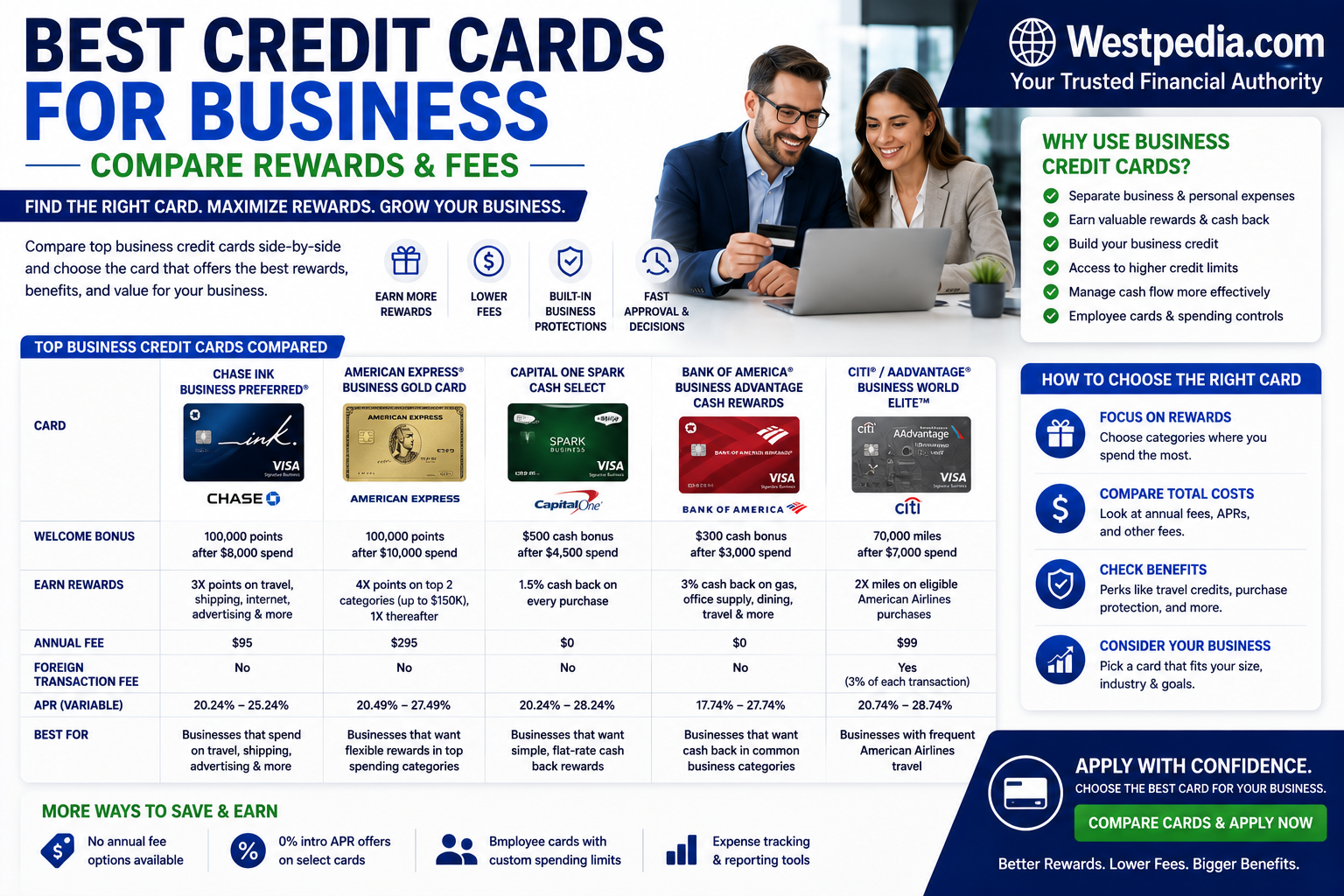
Best Credit Cards for Business in 2026: Complete Guide to Rewards, Fees & Approval Requirements
Business credit cards are designed specifically for business-related purchases and often provide features not commonly found on personal credit cards, including:
- Employee cards
- Expense tracking tools
- Higher credit limits
- Business rewards programs
- Travel benefits
- Accounting software integrations
- Detailed spending reports
- Business purchase protections
The best business credit card depends on how and where your company spends money.
Best Business Credit Cards by Category
| Category | Best For | Typical Benefit |
|---|---|---|
| Cash Back Business Cards | Everyday business spending | Simple cash rewards |
| Travel Business Cards | Frequent business travel | Points, miles, travel perks |
| No Annual Fee Cards | Cost-conscious businesses | Lower ownership cost |
| Premium Business Cards | High-spending companies | Enhanced benefits and credits |
| 0% APR Business Cards | Large planned purchases | Temporary financing flexibility |
| Business Credit Builder Cards | New businesses | Establishing payment history |
What Financial Problem Does a Business Credit Card Solve?
Business credit cards help solve several common operational challenges:
- Managing cash flow gaps
- Tracking business expenses
- Separating personal and company finances
- Managing employee spending
- Earning rewards on operational purchases
- Building business credit profiles
Many businesses use credit cards for recurring expenses such as software subscriptions, advertising campaigns, fuel purchases, inventory purchases, travel expenses, and office supplies. For larger funding needs beyond day-to-day spending, some companies may also consider a Small Business Loan to support expansion, equipment purchases, working capital, or other long-term business objectives.
How Business Credit Cards Work
A business credit card provides a revolving credit line that can be used for company purchases. Cardholders receive monthly statements and can either:
- Pay the balance in full
- Carry a balance and pay interest
- Utilize promotional financing periods when available
Paying balances in full each month generally helps avoid interest charges while maximizing rewards value.
Key Features Comparison Table
| Feature | Business Benefit |
|---|---|
| Employee Cards | Delegate spending authority |
| Expense Tracking | Simplified bookkeeping |
| Cash Back Rewards | Direct return on spending |
| Travel Rewards | Reduced travel costs |
| Purchase Protection | Coverage on eligible purchases |
| Extended Warranty | Additional product protection |
| Spending Controls | Manage employee expenses |
| Accounting Integration | Improved reporting efficiency |
Rewards Breakdown & Real-World Value
Business rewards programs typically focus on common company spending categories.
| Spending Category | Annual Spend | Reward Rate | Estimated Annual Value |
|---|---|---|---|
| Advertising | $12,000 | 3% | $360 |
| Travel | $10,000 | 3% | $300 |
| Office Supplies | $6,000 | 2% | $120 |
| Software Subscriptions | $4,000 | 2% | $80 |
In this example, annual rewards could exceed $860 before considering welcome bonuses or additional perks.
Rewards & Fees Table
| Reward Category | Typical Earnings Rate |
|---|---|
| General Purchases | 1%–2% |
| Travel | 2x–5x points |
| Advertising | 2%–5% |
| Shipping | 2%–5% |
| Office Supplies | 2%–5% |
| Fuel | 2%–5% |
First-Year Value Analysis Example
| Component | Estimated Value |
|---|---|
| Welcome Bonus | $750 |
| Annual Rewards | $860 |
| Statement Credits | $150 |
| Annual Fee | -$95 |
| Estimated Net Value | $1,665 |
Actual results vary based on spending patterns, redemption methods, annual fees, and issuer terms.
Fees and APR Explained
Annual Fees
- No annual fee: $0
- Mid-tier business cards: $95–$199
- Premium business cards: $395–$695+
APR Range
Business card APRs often range from approximately 18% to 35%, depending on creditworthiness and market conditions.
Intro APR Offers
Some business cards offer introductory 0% APR periods on purchases.
Balance Transfer Fees
Usually 3%–5% when available.
Foreign Transaction Fees
Typically 0%–3%.
Late Payment Fees
Fees vary according to issuer policies and account terms.
Cash Advance Fees
Generally charged as a percentage of the transaction amount.
Credit Score Requirements
| Credit Profile | Typical FICO Range | Business Card Access |
|---|---|---|
| Poor | 300–579 | Limited options |
| Fair | 580–669 | Entry-level products |
| Good | 670–739 | Broad availability |
| Very Good | 740–799 | Premium rewards products |
| Excellent | 800–850 | Highest approval potential |
Most issuers review personal credit profiles even when evaluating business card applications.
Issuer Comparison Table
| Issuer | Best For | Typical Credit Needed |
|---|---|---|
| Chase | Travel rewards | Good to Excellent |
| American Express | Premium business spending | Good to Excellent |
| Capital One | Flexible rewards | Good to Excellent |
| Citi | Cash back | Good to Excellent |
| Discover | Limited business offerings | Varies |
| Bank of America | Relationship rewards | Good to Excellent |
| Wells Fargo | Everyday business spending | Good to Excellent |
Issuer Insights
Chase
Best For: Travel-focused businesses.
Strengths: Strong transfer partner ecosystem.
Weaknesses: Competitive approval standards.
American Express
Best For: High-spending businesses.
Strengths: Premium benefits and travel perks.
Weaknesses: Higher annual fees on some products.
Capital One
Best For: Simplicity and flexible rewards.
Strengths: Straightforward earning structures.
Weaknesses: Product features vary widely.
Citi
Best For: Cash-back-focused businesses.
Strengths: Practical reward structures.
Weaknesses: Smaller business card portfolio.
Bank of America
Best For: Existing banking customers.
Strengths: Relationship-based reward enhancements.
Weaknesses: Maximum value often requires account relationships.
Wells Fargo
Best For: Everyday spending.
Strengths: Straightforward rewards.
Weaknesses: Benefits vary by product.
Approval Factors
Issuers typically evaluate:
- Credit score
- Payment history
- Credit utilization ratio
- Business revenue
- Debt-to-income ratio
- Recent credit inquiries
- Existing credit accounts
- Length of credit history
Approval Process Explained
1. Application Submission
Business and personal information is submitted.
2. Credit Review
The issuer reviews credit history and risk indicators.
3. Underwriting Assessment
Income, creditworthiness, and business factors are evaluated.
4. Approval or Denial
The issuer determines eligibility.
5. Card Issuance
Approved applicants receive cards by mail.
6. Activation
The card must be activated before use.
How to Improve Approval Odds
- Maintain on-time payments
- Reduce revolving balances
- Monitor credit reports
- Avoid excessive applications
- Provide accurate business information
How to Maximize Business Card Rewards
- Match rewards categories to spending patterns
- Use employee spending controls
- Redeem rewards strategically
- Track promotional bonus opportunities
- Take advantage of statement credits
Benefits vs Risks
Benefits
- Cash flow flexibility
- Rewards earnings
- Business expense tracking
- Employee management tools
- Travel and purchase protections
Risks
- High APR costs
- Potential overspending
- Debt accumulation
- Late fees
- Credit profile damage from missed payments
Alternatives to Consider
- Business charge cards
- Business lines of credit
- SBA loans
- Business term loans
- Corporate cards
The best alternative depends on financing needs, repayment ability, and spending patterns.
Expert Considerations
Before applying, compare annual fees, rewards potential, redemption flexibility, travel benefits, and borrowing costs. Review issuer disclosures carefully, understand APR structures, and estimate realistic reward earnings based on actual business spending.
Approval is never guaranteed. APRs, rewards, benefits, and promotional offers may change. Business owners should review official issuer disclosures before applying.
Frequently Asked Questions
1. What is the best credit card for business?
The best option depends on spending habits, travel needs, and business goals.
2. Can sole proprietors get business credit cards?
Many issuers allow sole proprietors and freelancers to apply.
3. What credit score is needed?
Many rewards-focused business cards target applicants with good to excellent credit.
4. Are business rewards taxable?
Tax treatment varies based on circumstances and applicable regulations.
5. Do business cards help build business credit?
Some issuers report activity to business credit bureaus.
6. Are employee cards free?
Many issuers offer employee cards at no additional cost.
7. What APR should I expect?
Rates vary based on creditworthiness and issuer policies.
8. Do business cards affect personal credit?
Many issuers review personal credit and may report certain account activity.
9. How long does approval take?
Some approvals are instant, while others require manual review.
10. Can startups qualify?
Many startups can qualify if they meet issuer requirements.
11. Are annual fees worth paying?
Potentially, if rewards and benefits exceed the annual fee cost.
12. What are foreign transaction fees?
Fees charged on qualifying international purchases.
13. Can business cards be used internationally?
Many cards support global purchases and travel spending.
14. Why was my application denied?
Common reasons include credit profile concerns, income limitations, or recent inquiries.
15. Should I carry a balance?
Many businesses seek to avoid carrying balances due to potentially high interest costs.
Related Topics
- Best Cash Back Credit Cards
- How Credit Scores Affect Approval
- Balance Transfer Credit Cards
- Travel Rewards Programs
- Credit Card APR Explained