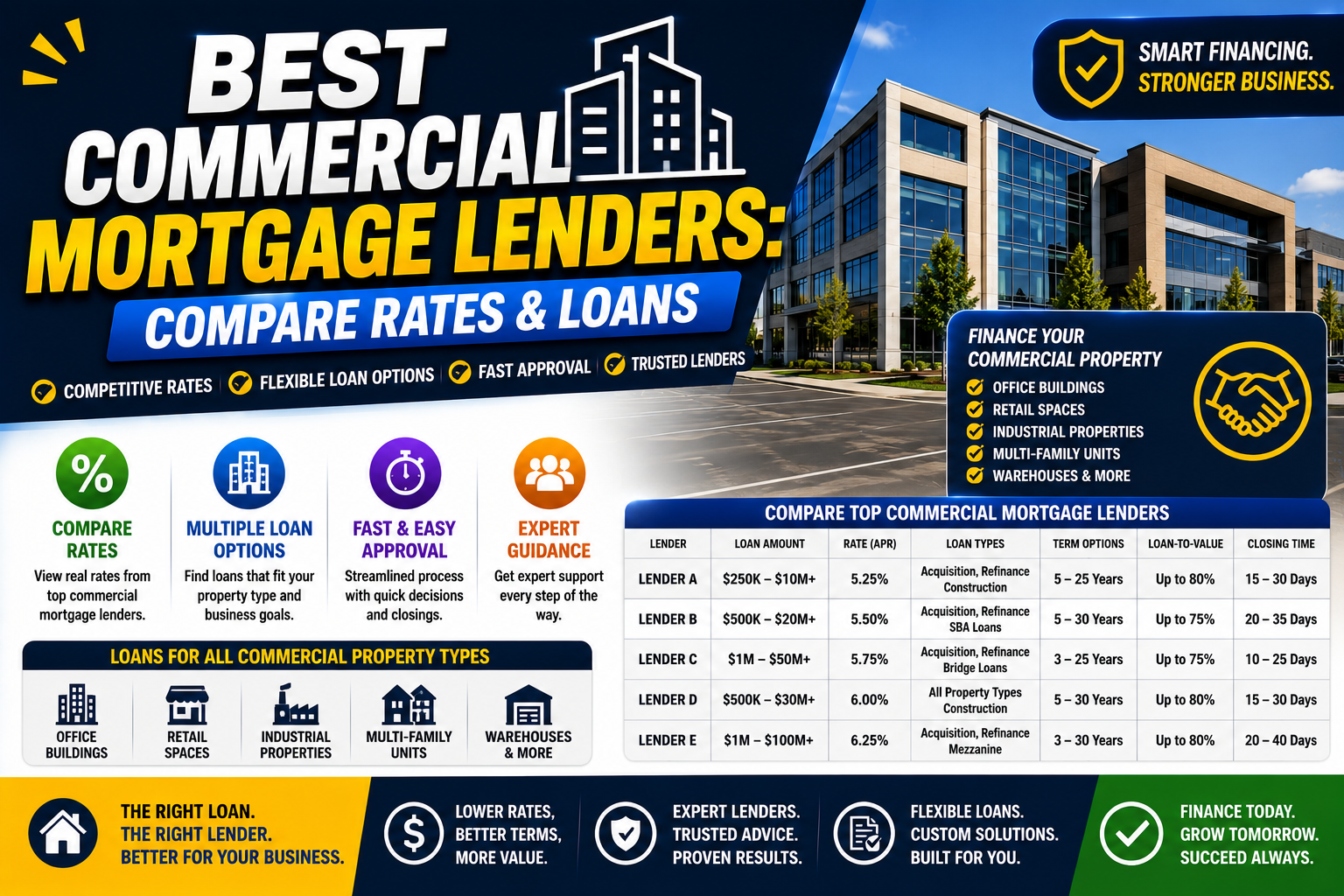
The best commercial mortgage lenders offer financing solutions for office buildings, retail properties, warehouses, multifamily investments, and owner-occupied business properties. Choosing the right lender depends on loan size, property type, credit profile, cash flow, and down payment. Comparing rates, fees, underwriting standards, and loan programs can help borrowers find financing that aligns with their business and investment goals.
WordPress HTML Article
Best Commercial Mortgage Lenders: Complete Guide to Rates, Loans, Approval Requirements, and Financing Options
Commercial real estate can be a powerful tool for business growth, wealth creation, and long-term investment. Whether you are purchasing an office building, multifamily property, retail center, warehouse, medical facility, or mixed-use development, selecting the right commercial mortgage lender can significantly affect financing costs, loan flexibility, and long-term profitability.
Unlike residential mortgages, commercial financing focuses heavily on business performance, property income, borrower experience, liquidity, and risk management. Because lenders vary significantly in their underwriting standards and loan offerings, comparing multiple options is often one of the most important steps in securing financing.
This guide examines the best commercial mortgage lenders, loan programs, approval requirements, costs, underwriting factors, refinancing opportunities, and borrower considerations.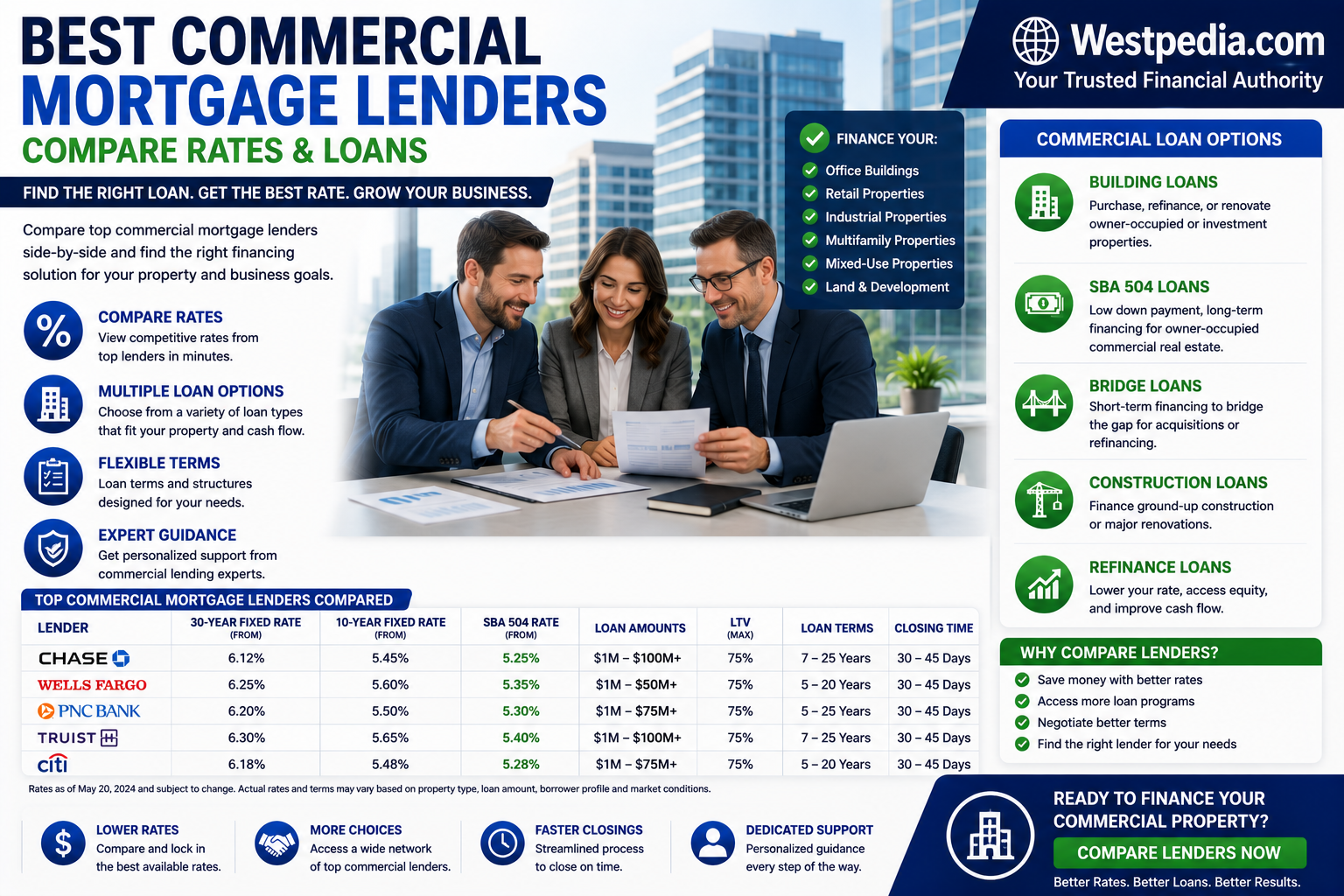
What Is a Commercial Mortgage Lender?
A commercial mortgage lender is a financial institution that provides financing for income-producing or business-related real estate. These lenders evaluate both the borrower and the property to determine eligibility, risk, and loan pricing.
Commercial mortgage lenders may finance:
- Office buildings
- Retail centers
- Industrial properties
- Warehouses
- Multifamily apartment buildings
- Medical offices
- Hotels
- Mixed-use properties
- Owner-occupied business properties
Why Commercial Borrowers Compare Multiple Lenders
Commercial lending is highly customized. Unlike many residential mortgage products, commercial loan structures can vary significantly among lenders.
Comparing lenders may help borrowers evaluate:
- Interest rates
- APR and total borrowing costs
- Maximum loan amounts
- Loan terms
- Prepayment penalties
- Approval requirements
- Funding timelines
- Property eligibility standards
Who Should Consider Commercial Mortgage Financing?
- Business owners purchasing facilities
- Real estate investors
- Developers
- Entrepreneurs expanding operations
- Multifamily property investors
- Commercial property owners refinancing existing debt
Who May Not Be a Good Fit?
- Businesses with unstable revenue
- Borrowers lacking required down payment funds
- Investors with insufficient reserves
- Projects with uncertain cash flow projections
Commercial Mortgage Types Comparison
| Loan Type | Down Payment | Credit Requirements | Best For | Potential Drawbacks |
|---|---|---|---|---|
| Conventional Commercial Loan | 20%-35% | Strong | Established businesses | Stricter approval standards |
| SBA 7(a) | 10%-20% | Moderate to Strong | Small businesses | Longer approval process |
| SBA 504 | 10%-15% | Strong | Owner-occupied properties | Usage restrictions |
| Bridge Loan | 20%-35% | Flexible | Short-term financing | Higher rates |
| CMBS Loan | 20%-30% | Strong | Large investment properties | Less servicing flexibility |
| Fixed-Rate Loan | Varies | Strong | Payment stability | Potentially higher starting rate |
| Adjustable-Rate Loan | Varies | Strong | Lower initial payments | Future rate volatility |
Best Commercial Mortgage Lenders Comparison
| Lender | Best For | Strengths | Loan Programs | Potential Limitations |
|---|---|---|---|---|
| Wells Fargo | Large commercial borrowers | Extensive commercial lending experience | CRE, construction, multifamily | Stricter qualification standards |
| Bank of America | Established businesses | Broad banking relationship benefits | Commercial mortgages, SBA loans | May prioritize larger borrowers |
| Chase | Middle-market businesses | National footprint | Commercial real estate financing | Property-specific requirements |
| U.S. Bank | Owner-occupied properties | Diverse lending options | SBA and commercial loans | Regional availability variations |
| PNC Bank | Commercial property investors | Relationship-based lending | Commercial acquisition and refinance | Qualification varies by market |
| Live Oak Bank | SBA borrowers | SBA specialization | SBA 7(a), SBA 504 | Primarily SBA-focused |
| BMO | Commercial expansion | Business banking integration | Commercial mortgages | Program availability varies |
| KeyBank | Commercial investors | Multifamily expertise | CRE financing | May require stronger borrower profiles |
Commercial Mortgage Interest Rates
Commercial mortgage rates depend on:
- Property type
- Loan amount
- Occupancy status
- Borrower creditworthiness
- Property cash flow
- Market conditions
Commercial mortgage rates commonly range from approximately 6% to 11%, although actual pricing varies substantially by lender and borrower profile.
APR vs Interest Rate
Interest rates reflect borrowing costs, while APR incorporates lender fees and financing expenses, offering a broader measure of loan cost.
Commercial Mortgage Cost Breakdown
| Cost Category | Typical Range | Purpose |
|---|---|---|
| Down Payment | 20%-35% | Borrower equity contribution |
| Origination Fee | 0.5%-2% | Loan processing |
| Appraisal Fee | $2,000-$10,000+ | Property valuation |
| Environmental Review | $1,000-$5,000+ | Risk assessment |
| Legal Fees | $1,500-$15,000+ | Documentation review |
| Title Insurance | Varies | Ownership protection |
| Escrow Costs | Varies | Transaction management |
| Recording Fees | Varies | Government filing |
Commercial Mortgage Payment Structure
Commercial mortgage payments may include:
- Principal
- Interest
- Property taxes
- Hazard insurance
- Flood insurance when required
- Association fees
- Reserve requirements
Commercial Property Affordability Analysis
Commercial lenders focus heavily on property performance and cash flow.
Key Metrics
- Debt Service Coverage Ratio (DSCR)
- Net Operating Income (NOI)
- Loan-to-Value Ratio (LTV)
- Liquidity and reserves
- Business cash flow
DSCR Example
Annual NOI: $180,000
Annual Debt Payments: $135,000
DSCR = 1.33
Many lenders prefer DSCR levels above 1.20 to 1.30, depending on property type and risk profile.
Commercial Mortgage Underwriting Factors
Credit Profile
- Business credit history
- Personal credit score
- Payment history
- Collections
- Bankruptcies
- Foreclosures
Income Verification
- Business tax returns
- Personal tax returns
- Profit and loss statements
- Rental income records
Employment and Business Stability
Lenders generally prefer businesses with stable operating histories and demonstrated management experience.
Assets and Reserves
Strong liquidity can improve approval prospects and support better financing terms.
Loan-to-Value Ratio (LTV)
Commercial lenders commonly finance 65% to 80% of a property’s value.
Property and Collateral Analysis
Why Appraisals Matter
Commercial appraisals determine market value and help lenders evaluate collateral quality.
Property Eligibility Standards
- Location quality
- Occupancy levels
- Property condition
- Income stability
- Market demand
- Zoning compliance
Equity Calculations
Property equity equals current market value minus outstanding debt balances.
Commercial Mortgage Refinance Analysis
Reasons to Refinance
- Reduce borrowing costs
- Improve cash flow
- Modify loan structure
- Access property equity
- Extend loan maturity
Break-Even Analysis
Commercial borrowers should compare refinancing costs against projected savings to estimate the break-even period.
Cash-Out Refinance Risks
- Higher debt obligations
- Reduced equity
- Potential payment increases
Commercial Mortgage Application Process
- Initial lender consultation
- Prequalification review
- Property analysis
- Loan application submission
- Financial documentation review
- Credit assessment
- Appraisal and environmental reports
- Underwriting review
- Conditional approval
- Final approval
- Closing
- Funding
How to Improve Commercial Mortgage Approval Odds
- Improve personal and business credit
- Increase down payment funds
- Strengthen business cash flow
- Reduce existing debt obligations
- Build liquidity reserves
- Maintain organized financial records
Common Commercial Borrowing Mistakes
- Failing to compare lenders
- Underestimating closing costs
- Overestimating future rental income
- Ignoring reserve requirements
- Overleveraging the property
- Overlooking prepayment penalties
Local and Regulatory Considerations
Commercial lending regulations vary by state and jurisdiction. Property taxes, licensing requirements, closing costs, recording fees, and available loan programs may differ by location.
Frequently Asked Questions
1. Who are the best commercial mortgage lenders?
The best lender depends on property type, loan size, borrower qualifications, and financing goals.
2. What credit score is needed?
Most lenders prefer strong credit profiles, though requirements vary.
3. How much down payment is required?
Commercial loans commonly require 20% to 35% down.
4. What is DSCR?
Debt Service Coverage Ratio measures a property’s ability to cover debt payments.
5. How long does approval take?
Commercial loan approvals may take several weeks to several months.
6. Are SBA loans commercial mortgages?
SBA programs can be used for qualifying commercial real estate purchases.
7. Are appraisals required?
Most commercial lenders require property appraisals.
8. What affects commercial rates?
Credit quality, property performance, loan size, and market conditions.
9. Can startups qualify?
Some lenders finance startups, though additional requirements often apply.
10. What is LTV?
Loan-to-Value Ratio compares the loan amount to property value.
11. Can commercial mortgages be refinanced?
Yes, subject to lender and property qualification.
12. What documents are needed?
Tax returns, financial statements, bank statements, and property records.
13. Are fixed-rate loans available?
Many commercial lenders offer fixed-rate financing options.
14. What reserves are required?
Reserve requirements vary by lender and property type.
15. Should I compare multiple lenders?
Yes. Comparing multiple lenders can help borrowers evaluate costs, programs, and financing structures.
Related Topics
- Commercial Mortgage Rates
- Commercial Real Estate Loans
- SBA 504 Loans
- SBA 7(a) Financing
- Commercial Mortgage Refinance
- Multifamily Property Loans
- Bridge Loans
- Commercial Property Appraisals
- Debt Service Coverage Ratio (DSCR)
- Commercial Real Estate Investing
Bottom Line: The best commercial mortgage lender depends on your property type, investment strategy, financial profile, and long-term objectives. Comparing multiple lenders, understanding underwriting requirements, evaluating total borrowing costs, and analyzing affordability can help support more informed commercial real estate financing decisions. Consulting a Best Mortgage Broker may also help borrowers access a wider range of lending options and identify financing solutions that align with their specific real estate goals.