Choosing among the best investment firms is an important step for investors seeking to build wealth, save for retirement, generate income, or preserve capital. An investment firm can provide access to financial markets, investment research, portfolio management, retirement planning, and advisory services.
Because no single firm is ideal for every investor, understanding fees, investment options, risk management tools, and available services is essential before opening an account.
This guide explains how investment firms operate, compares major providers, analyzes risks and costs, and helps investors determine which type of firm may align with their financial objectives.
Investing
Firms
Wealth Building
ETFs
Mutual Funds
Best Investment Firms: How to Compare Providers for Long-Term Investing
An investment firm is a financial institution that offers investment products and services to individual and institutional investors. Depending on the provider, services may include:
- Brokerage accounts
- Retirement accounts
- Financial planning
- Portfolio management
- Robo-advisory services
- Investment research
- Mutual funds and ETFs
- Income and fixed-income investing
Investment firms may help investors pursue several financial objectives:
- Long-term wealth accumulation
- Retirement planning
- Income generation
- Capital preservation
- Inflation protection
- Tax-efficient investing
Investment Characteristics Table
| Feature | Details |
|---|---|
| Primary Purpose | Provide investment products and advisory services |
| Account Types | Brokerage, IRA, retirement, managed accounts |
| Investment Options | Stocks, ETFs, mutual funds, bonds, cash investments |
| Liquidity | Depends on investments selected |
| Risk Level | Varies by portfolio composition |
| Income Potential | Possible through dividends and interest |
| Growth Potential | Dependent on investment strategy |
| Tax Considerations | Based on account structure and holdings |
Who Are Investment Firms Suitable For?
- Beginners: Investors seeking educational support and simple investing solutions.
- Intermediate Investors: Investors needing broader research and portfolio tools.
- Advanced Investors: Investors requiring advanced trading and analytics.
- Retirees: Investors focused on retirement income and wealth preservation.
- Income Investors: Investors seeking dividends and fixed-income opportunities.
- Growth Investors: Investors pursuing long-term capital appreciation.
- Risk-Averse Investors: Investors emphasizing diversification and capital preservation.
How Investment Firms Work
Investment firms connect investors to financial markets while offering varying degrees of support and advice.
After opening and funding an account, investors can:
- Research investment opportunities.
- Purchase securities.
- Build diversified portfolios.
- Monitor performance.
- Rebalance investments.
- Access financial planning resources.
Some firms primarily support self-directed investing, while others emphasize professional portfolio management or comprehensive wealth management.
Historical Context
Traditional investment firms historically relied on full-service brokerage models. Technological advances have expanded access to lower-cost investing solutions, online trading platforms, and automated portfolio management.
Today, investors can choose among self-directed brokerage firms, hybrid advisory models, and comprehensive wealth management organizations.
Expected Return Drivers
Investment firms do not directly create investment returns. Instead, portfolio outcomes depend on:
- Asset allocation decisions
- Market performance
- Corporate earnings growth
- Interest rates
- Economic conditions
- Investment costs and fees
- Investor behavior and discipline
Diversification, long-term investing, and cost management often influence overall investment results.
Risk Assessment Framework
Market Risk
Portfolio values may decline during market downturns.
Interest-Rate Risk
Fixed-income investments can lose value when interest rates rise.
Inflation Risk
Inflation may erode purchasing power over time.
Liquidity Risk
Certain investments may be difficult to sell quickly.
Concentration Risk
Excessive exposure to one investment or sector may increase losses.
Credit Risk
Bond issuers may default on obligations.
Currency Risk
International investments can fluctuate due to exchange-rate changes.
Volatility Risk
Short-term market fluctuations may significantly affect portfolio values.
Regulatory Risk
Changes in laws or regulations may affect investment strategies and returns.
Realistic Risk Scenario
An investor selects a high-growth portfolio without considering risk tolerance. During a market correction, substantial losses lead to emotional selling and potentially permanent capital impairment. Choosing a Best Online Investment Platform and comparing Best Investment Platforms can help investors access tools, diversification options, and educational resources that support more disciplined, long-term investing decisions.
Risk vs Return Table
| Risk Level | Return Potential | Investor Type |
|---|---|---|
| Low | Generally Lower | Conservative investors |
| Moderate | Moderate | Balanced investors |
| Moderately High | Potentially Higher | Long-term growth investors |
| High | Potentially High but Uncertain | Aggressive investors |
Investment Cost Analysis
Fees can significantly affect long-term investment outcomes.
Trading Fees
Many firms offer commission-free stock and ETF trading.
Expense Ratios
Funds may charge annual operating expenses.
Management Fees
Managed portfolios and advisory programs often include annual management charges.
Advisory Fees
Comprehensive financial planning services may involve additional costs.
Tax Costs
Investment gains, dividends, and interest income may create tax obligations.
Opportunity Costs
Holding excessive cash can limit long-term portfolio growth.
Spread Costs
Bid-ask spreads may affect trading efficiency.
Even modest fee differences can compound significantly over long investment horizons.
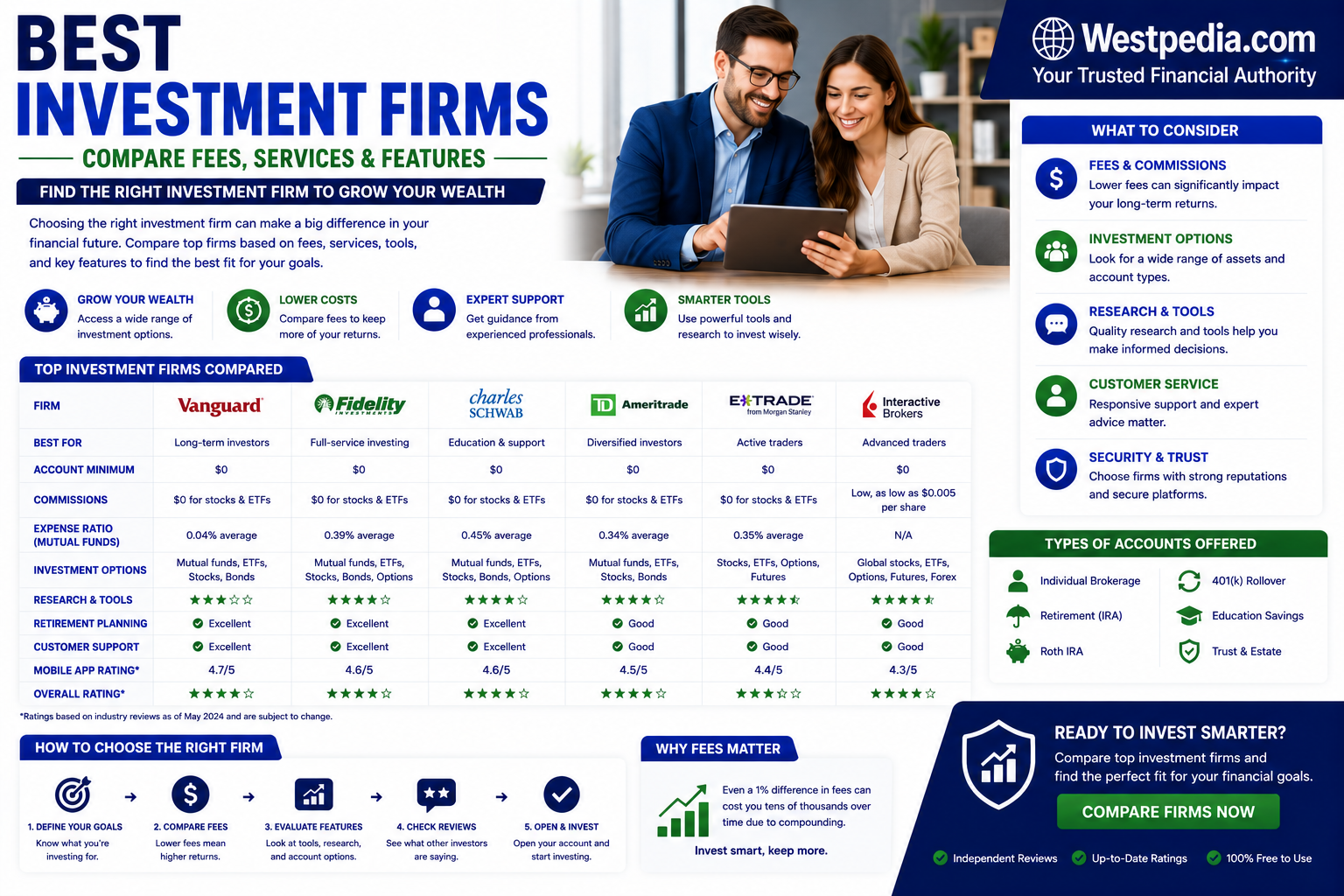
Best Investment Firms Comparison
| Platform | Best For | Fees | Research Tools |
|---|---|---|---|
| Vanguard | Passive and retirement investors | Generally low | Strong fund research |
| Fidelity | Broad investor needs | Competitive | Extensive market research |
| Charles Schwab | Retirement and advisory services | Competitive | Comprehensive planning tools |
| E*TRADE | Active investors | Competitive | Advanced trading tools |
| Interactive Brokers | Experienced and global investors | Low-cost structure | Institutional-grade analytics |
| Robinhood | Beginning investors | Low-cost access | Basic research tools |
| Merrill Edge | Bank-integrated investing | Competitive | Strong financial planning resources |
Investment Firm Analysis
Vanguard: Often preferred by long-term index investors seeking low costs.
Fidelity: Offers extensive research, investment options, and educational resources.
Charles Schwab: Provides a broad range of advisory and retirement services.
E*TRADE: Suitable for active investors requiring advanced trading features.
Interactive Brokers: Designed for sophisticated investors seeking global market access.
Robinhood: Focuses on simplicity and accessibility for newer investors.
Merrill Edge: Appeals to investors wanting integrated banking and investing solutions.
Portfolio Fit Analysis
Investment firms serve as the foundation for implementing diversified investment strategies.
Investors can use these firms to establish:
- Core long-term holdings
- Retirement portfolios
- Income portfolios
- Diversified multi-asset portfolios
- Tax-efficient investment strategies
Portfolio construction should align with an investor’s objectives, risk tolerance, and time horizon.
Investment Alternatives Table
| Alternative | Pros | Cons | Suitable For |
|---|---|---|---|
| Self-Directed Brokerage | Greater control and flexibility | Requires investor involvement | Experienced investors |
| Robo-Advisor | Automated portfolio management | Limited customization | Passive investors |
| Traditional Financial Advisor | Personalized guidance | Potentially higher fees | Investors seeking comprehensive advice |
| Employer Retirement Plan | Convenient retirement savings | Limited investment choices | Retirement-focused investors |
| Investment Firm | Broad investment access | Fees and service quality vary | Most investors |
Asset Comparison Framework
Stocks vs ETFs
Stocks offer concentrated exposure, while ETFs provide diversification.
ETFs vs Mutual Funds
ETFs often offer lower costs and trading flexibility, while mutual funds may provide active management.
Growth vs Value Investing
Growth investing targets expanding businesses, whereas value investing focuses on perceived undervaluation.
Active vs Passive Investing
Passive investing seeks market tracking, while active investing aims to outperform benchmarks.
Bonds vs Stocks
Bonds may offer income and stability, while stocks generally provide greater growth potential.
Real Estate vs Equities
Real estate can diversify portfolios, whereas equities often drive long-term growth.
Dividend vs Growth Investing
Dividend strategies emphasize income, while growth strategies focus on capital appreciation.
Economic Factors Affecting Investments
- Inflation: Can reduce real investment returns.
- Interest Rates: Influence asset valuations.
- Economic Growth: Often supports corporate earnings.
- Recessions: May negatively affect portfolio values.
- Market Cycles: Bull and bear markets impact investor outcomes.
- Federal Reserve Policy: Monetary policy affects financial markets.
- Global Events: Geopolitical developments may increase volatility.
Investor Strategies
- Use dollar-cost averaging to reduce timing risk.
- Maintain diversification across asset classes.
- Rebalance portfolios periodically.
- Align investments with long-term goals.
- Manage position sizes appropriately.
- Review investment costs regularly.
Common Investor Mistakes
- Chasing recent performance
- Attempting market timing
- Ignoring fees
- Failing to diversify
- Emotional investing
- Overconcentration in a single asset
- Neglecting periodic portfolio reviews
- Setting unrealistic expectations
Expert Considerations
Before selecting an investment firm, investors should compare:
- Account minimums
- Research quality
- Investment choices
- Advisory services
- Customer support
- Trading tools
- Retirement planning features
- Fee schedules
- Security and account protections
Frequently Asked Questions
1. What is an investment firm?
An investment firm provides investment products, brokerage services, and financial guidance.
2. Which investment firm is best for beginners?
The best choice depends on educational resources, fees, and ease of use.
3. Are investment firms safe?
Regulated firms typically provide investor protections, but investment losses remain possible.
4. Can I lose money investing through an investment firm?
Yes. Investment values fluctuate and may decline.
5. What fees should investors evaluate?
Trading costs, advisory fees, expense ratios, and account fees.
6. How do taxes affect investments?
Taxes can reduce after-tax returns depending on account type and investment activity.
7. Are managed portfolios worth considering?
Suitability depends on an investor’s experience, goals, and willingness to pay management fees.
8. How much money do I need to start investing?
Minimum investment requirements vary by provider and account type.
9. What is diversification?
Diversification involves spreading investments across multiple assets to manage risk.
10. How often should portfolios be reviewed?
Investors often review portfolios periodically to maintain alignment with objectives.
11. What happens during market downturns?
Portfolio values may decline temporarily due to market volatility.
12. Should I choose active or passive investing?
Both approaches have potential benefits and limitations depending on investor preferences.
13. Are investment firms suitable for retirees?
Many firms provide retirement planning and income-focused services.
14. Can investment firms help with retirement planning?
Many providers offer retirement accounts, calculators, and advisory services.
15. How do I compare investment firms?
Compare fees, investment options, research tools, customer service, and advisory offerings.
Important Investment Disclosures
All investments involve risk, including the possible loss of principal. Investments can lose value, and past performance does not guarantee future results.
Investors should conduct their own research before making investment decisions. Tax consequences vary by individual circumstances.
Professional financial, tax, or legal advice may be appropriate depending on individual needs and objectives.
Related Topics
- Portfolio Diversification Strategies
- Index Fund Investing
- ETF vs Mutual Fund Comparison
- Risk Management for Investors
- Long-Term Wealth Building