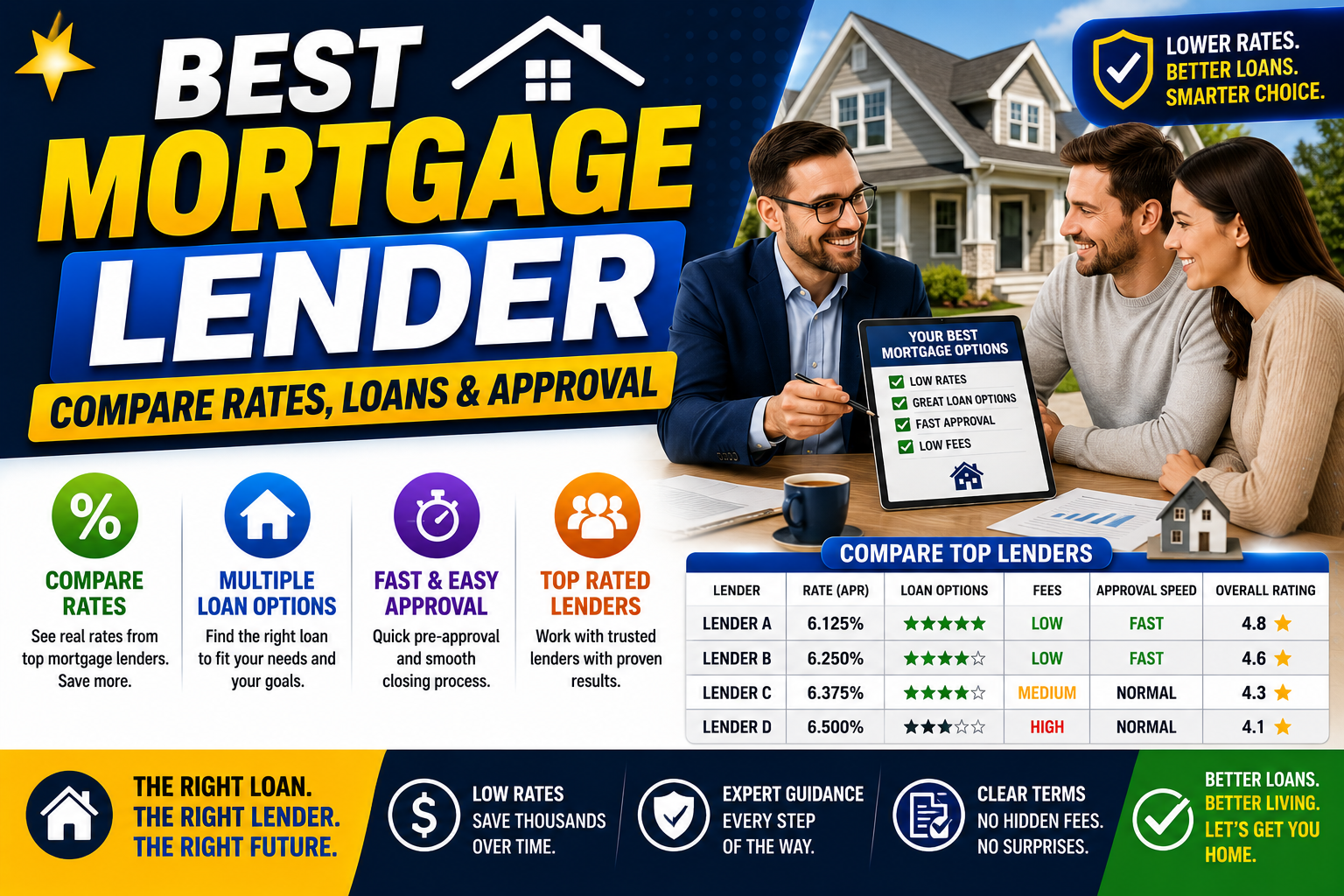
A mortgage lender is a financial institution that provides funds for home purchases, refinancing, and other real estate financing needs. Choosing the right mortgage lender matters because rates, fees, loan programs, and approval requirements can vary significantly. Borrowers should compare multiple lenders, evaluate affordability, and understand underwriting standards including credit score, income, debt-to-income ratio, assets, and property qualifications.
Mortgage Lender: Complete Guide to Rates, Loan Options, Costs, and Approval Requirements
Selecting the right mortgage lender is one of the most important decisions in the homebuying journey. While many borrowers focus primarily on interest rates, lenders differ in loan programs, underwriting flexibility, customer service, closing costs, digital tools, and overall borrowing experience.
Whether you are purchasing your first home, refinancing an existing mortgage, buying a second property, or investing in real estate, understanding how mortgage lenders operate can help you make more informed financial decisions.
This comprehensive guide explains mortgage lenders, compares major lending options, examines approval requirements, reviews mortgage costs, and helps borrowers navigate the mortgage process with confidence.

What Is a Mortgage Lender?
A mortgage lender is a financial institution that provides funds for purchasing or refinancing real estate. Lenders evaluate borrower qualifications, determine loan eligibility, establish interest rates, and manage the underwriting process.
Mortgage lenders include:
- Banks
- Credit unions
- Mortgage companies
- Online lenders
- Government-backed lending programs
Unlike mortgage brokers, lenders directly fund or originate mortgage loans.
What Financial Need Does a Mortgage Lender Solve?
Most homebuyers do not have sufficient cash to purchase property outright. Mortgage lenders provide financing that allows borrowers to spread homeownership costs over many years.
Mortgage financing helps:
- Purchase primary residences
- Buy second homes
- Acquire investment properties
- Refinance existing mortgages
- Access home equity
- Build long-term property ownership
Who Should Consider Working With a Mortgage Lender?
- First-time homebuyers
- Move-up buyers
- Real estate investors
- Homeowners refinancing mortgages
- Borrowers seeking home equity access
Who May Not Be a Good Fit?
- Borrowers with unstable income
- Applicants with excessive debt obligations
- Individuals lacking minimum down payment funds
- Borrowers not yet financially prepared for homeownership costs
Homeownership Goals and Long-Term Financial Implications
Mortgage financing enables homeownership while preserving liquidity. However, borrowers should recognize that a mortgage is a long-term financial obligation that affects monthly cash flow, future borrowing capacity, and overall financial planning.
Successful homeownership requires balancing housing goals with affordability, emergency savings, retirement planning, and future financial flexibility.
Types of Mortgage Lenders
Banks
Traditional banks offer mortgage products alongside checking, savings, and other financial services.
Credit Unions
Credit unions often provide member-focused lending programs and personalized service.
Mortgage Companies
These institutions specialize primarily in mortgage lending and refinancing.
Online Mortgage Lenders
Digital lenders emphasize technology-driven applications, streamlined approvals, and online account management.
Mortgage Types Comparison
| Mortgage Type | Down Payment | Credit Requirements | Best For | Potential Drawbacks |
|---|---|---|---|---|
| Conventional Loan | 3%-20% | Generally 620+ | Strong-credit borrowers | PMI may apply |
| FHA Loan | 3.5% | Flexible standards | First-time buyers | MIP costs |
| VA Loan | 0% | Military eligibility | Veterans and service members | Funding fee may apply |
| USDA Loan | 0% | Income limits apply | Rural homebuyers | Location restrictions |
| Jumbo Loan | 10%-20%+ | Strong credit profile | High-value properties | Stricter approval standards |
| ARM | Varies | Varies | Short-term ownership plans | Future rate adjustments |
| Fixed-Rate Mortgage | Varies | Varies | Payment stability | Potentially higher initial rate |
Mortgage Interest Rates Explained
Mortgage rates vary based on:
- Credit score
- Loan amount
- Property type
- Down payment
- Occupancy status
- Loan term
- Market conditions
In many market environments, mortgage rates commonly range between approximately 5% and 8%, although actual rates may be higher or lower depending on economic conditions and borrower qualifications.
APR vs Interest Rate
The interest rate reflects the cost of borrowing money. APR includes additional lender fees and financing costs, providing a more complete estimate of total loan expenses.
Fixed vs Adjustable Pricing
Fixed-rate mortgages maintain the same interest rate throughout the loan term, while adjustable-rate mortgages may change after an initial fixed period.
Mortgage Cost Breakdown
| Cost Category | Typical Range | Purpose |
|---|---|---|
| Down Payment | 0%-20%+ | Initial borrower investment |
| Origination Fees | 0%-1% | Loan processing |
| Appraisal Fees | $300-$800+ | Property valuation |
| Credit Report Fees | $25-$100+ | Credit review |
| Title Insurance | Varies | Ownership protection |
| Escrow Costs | Varies | Taxes and insurance reserves |
| Recording Fees | Varies | Government filing requirements |
Monthly Mortgage Payment Analysis
A typical mortgage payment may include:
- Principal
- Interest
- Property taxes
- Homeowners insurance
- HOA fees
- Mortgage insurance
Example Mortgage Payment
Home Price: $400,000
Down Payment: 10% ($40,000)
Loan Amount: $360,000
Monthly housing costs would include principal, interest, taxes, insurance, and any applicable HOA fees or mortgage insurance premiums.
Mortgage Insurance Explained
PMI (Private Mortgage Insurance)
PMI is typically required on conventional loans when the down payment is less than 20%.
FHA Mortgage Insurance Premium (MIP)
FHA loans generally require both upfront and ongoing mortgage insurance.
VA Funding Fee
Eligible VA borrowers may pay a funding fee unless exempt.
USDA Guarantee Fee
USDA loans may include upfront and annual guarantee fees.
Housing Affordability Analysis
Mortgage lenders evaluate affordability using multiple financial metrics.
Key Factors
- Income
- Debt obligations
- Credit score
- Down payment amount
- Cash reserves
- Housing expense ratio
- Debt-to-income ratio (DTI)
Affordability Example
A borrower earning $8,500 per month with $700 in existing monthly debt obligations may qualify differently than someone with the same income but significantly higher monthly debt payments.
Mortgage Underwriting Factors
Credit Profile
- Credit score
- Payment history
- Collections
- Bankruptcies
- Foreclosures
Income Verification
- W-2 income
- Self-employed income
- Commission income
- Rental income
Employment Stability
Lenders generally prefer consistent employment and predictable income patterns.
Debt-to-Income Ratio (DTI)
DTI compares monthly debt obligations to gross monthly income.
Assets and Reserves
Strong savings and reserves may strengthen a mortgage application.
Loan-to-Value Ratio (LTV)
LTV compares the mortgage amount to the appraised property value.
Occupancy Type
- Primary residence
- Second home
- Investment property
Occupancy affects loan pricing and underwriting standards.
Property and Collateral Analysis
Mortgage lenders rely on appraisals to verify property value and assess collateral risk.
Why Appraisals Matter
- Determine market value
- Support underwriting decisions
- Protect lender interests
- Reduce overvaluation risk
Property Eligibility Standards
- Structural condition
- Safety requirements
- Marketability
- Legal compliance
- Habitability standards
Major Mortgage Lender Comparison
| Lender | Best For | Strengths | Potential Limitations |
|---|---|---|---|
| Rocket Mortgage | Digital borrowers | Online convenience | Limited face-to-face service |
| Chase | Existing customers | Large banking network | Qualification standards vary |
| Bank of America | Relationship banking | Multiple mortgage products | Program availability varies |
| Wells Fargo | Traditional borrowers | National presence | Regional differences |
| U.S. Bank | Conventional loans | Broad loan selection | Market-specific availability |
| PNC Bank | Purchase and refinance | Flexible mortgage offerings | Requirements vary |
| Navy Federal Credit Union | Military members | Member-focused lending | Membership required |
| Veterans United | VA borrowers | VA expertise | Primarily military-focused |
| Better | Online applications | Digital-first experience | Limited branch support |
| LoanDepot | Broad loan options | Purchase and refinance solutions | Pricing varies |
| Rate | Fast approvals | Technology-driven platform | Product availability varies |
| Pennymac | Refinancing borrowers | Large servicing platform | Borrower experiences vary |
Mortgage Refinance Analysis
Reasons to Refinance
- Reduce interest costs
- Lower monthly payments
- Change loan terms
- Convert ARM to fixed-rate financing
- Access home equity
Refinance Costs
Refinancing may involve appraisal fees, lender charges, title costs, escrow expenses, and other closing costs.
Break-Even Analysis
Borrowers should compare refinance expenses against projected savings to determine how long it may take to recover costs.
Cash-Out Refinance Risks
- Higher loan balances
- Reduced equity
- Potentially longer repayment periods
Mortgage Application Process
- Mortgage prequalification
- Mortgage preapproval
- Home search
- Purchase agreement
- Mortgage application
- Documentation submission
- Underwriting review
- Property appraisal
- Conditional approval
- Final approval
- Closing process
- Funding timeline completion
How to Improve Mortgage Approval Odds
- Improve credit scores before applying
- Reduce outstanding debt balances
- Increase down payment funds
- Build emergency reserves
- Maintain employment stability
- Avoid major financial changes before closing
First-Time Homebuyer Guidance
- Explore FHA financing options
- Research state assistance programs
- Review down payment assistance opportunities
- Compare grant programs
- Complete homebuyer education courses when available
Local and Regulatory Considerations
Mortgage regulations vary by state. Property taxes, closing costs, licensing requirements, assistance programs, and loan availability may differ depending on location.
Frequently Asked Questions
1. What is a mortgage lender?
A mortgage lender provides financing for purchasing or refinancing real estate.
2. How do mortgage lenders make approval decisions?
They evaluate credit, income, assets, debts, and property qualifications.
3. What credit score is needed for a mortgage?
Requirements vary by lender and loan program.
4. How much down payment is required?
Requirements range from 0% to 20% or more depending on the loan.
5. What is PMI?
Private Mortgage Insurance may apply to certain conventional loans.
6. What is DTI?
Debt-to-Income Ratio measures debt obligations relative to income.
7. Do all lenders offer FHA loans?
No. Program availability varies by lender.
8. What is mortgage preapproval?
Preapproval provides a lender’s preliminary assessment of borrowing capacity.
9. How long does underwriting take?
Timelines vary based on documentation and lender processes.
10. What affects mortgage rates?
Credit profile, market conditions, down payment, and loan characteristics.
11. Can I refinance with a different lender?
Yes, borrowers may compare refinance offers from multiple lenders.
12. What is an appraisal?
An appraisal estimates a property’s market value.
13. FHA vs Conventional?
FHA loans generally offer more flexible qualification standards, while conventional loans may have different cost structures.
14. ARM vs Fixed-Rate?
Fixed-rate loans provide stable payments, while ARMs may adjust over time.
15. Are first-time buyer programs available?
Many states and local agencies offer assistance programs for eligible buyers.
Related Topics
- Best Mortgage Lenders
- Mortgage Broker Guide
- Mortgage Rates Today
- FHA Loan Requirements
- VA Loan Guide
- USDA Mortgage Programs
- Mortgage Refinance Options
- Home Equity Loans
- HELOC Guide
- First-Time Homebuyer Programs
Bottom Line: Choosing the right mortgage lender involves more than finding the lowest advertised rate. Borrowers should compare loan programs, fees, underwriting requirements, customer service, digital tools, and overall affordability. Careful comparison shopping and responsible financial planning can help support long-term homeownership success. Working with a Best Mortgage Broker may help borrowers evaluate multiple lending options efficiently, while monitoring Commercial Mortgage Rates can be especially important for those considering commercial property financing.